 |
ROOT
Reference Guide |

|
| |
ROOT
Reference Guide |
|
Class to handle efficiency histograms.
This class handles the calculation of efficiencies and their uncertainties. It provides several statistical methods for calculating frequentist and Bayesian confidence intervals as well as a function for combining several efficiencies.
Efficiencies have a lot of applications and meanings but in principle, they can be described by the fraction of good/passed events k out of sample containing N events. One is usually interested in the dependency of the efficiency on other (binned) variables. The number of passed and total events is therefore stored internally in two histograms (TEfficiency::fTotalHistogram and TEfficiency::fPassedHistogram). Then the efficiency, as well as its upper and lower error, can be calculated for each bin individually.
As the efficiency can be regarded as a parameter of a binomial distribution, the number of passed and total events must always be integer numbers. Therefore a filling with weights is not possible. However, you can assign a global weight to each TEfficiency object (TEfficiency::SetWeight). It is necessary to create one TEfficiency object for each weight if you investigate a process involving different weights. This procedure needs more effort but enables you to re-use the filled object in cases where you want to change one or more weights. This would not be possible if all events with different weights were filled in the same histogram.
If you start a new analysis, it is highly recommended to use the TEfficiency class from the beginning. You can then use one of the constructors for fixed or variable bin size and your desired dimension. These constructors append the created TEfficiency object to the current directory if TH1::AddDirectoryStatus() is true. It will be written automatically to a file during the next TFile::Write command.
Example: create a two-dimensional TEfficiency object with
TEfficiency* pEff = new TEfficiency("eff","my efficiency;x;y;#epsilon",10,0,10,20,-5,5);
If you already have two histograms filled with the number of passed and total events, you will use the constructor TEfficiency(const TH1& passed,const TH1& total) to construct the TEfficiency object. The histograms "passed" and "total" have to fulfill the conditions mentioned in TEfficiency::CheckConsistency, otherwise the construction will fail. As the histograms already exist, the new TEfficiency is by default not attached to the current directory to avoid duplication of data. If you want to store the new object anyway, you can either write it directly by calling TObject::Write or attach it to a directory using TEfficiency::SetDirectory. This also applies to TEfficiency objects created by the copy constructor TEfficiency::TEfficiency(const TEfficiency& rEff).In case you already have two filled histograms and you only want to plot them as a graph, you should rather use TGraphAsymmErrors::TGraphAsymmErrors(const TH1* pass,const TH1* total,Option_t* opt) to create a graph object.
You can fill the TEfficiency object by calling the TEfficiency::Fill(Bool_t bPassed,Double_t x,Double_t y,Double_t z) method. The "bPassed" boolean flag indicates whether the current event is good (both histograms are filled) or not (only TEfficiency::fTotalHistogram is filled). The x, y and z variables determine the bin which is filled. For lower dimensions, the z- or even the y-value may be omitted.
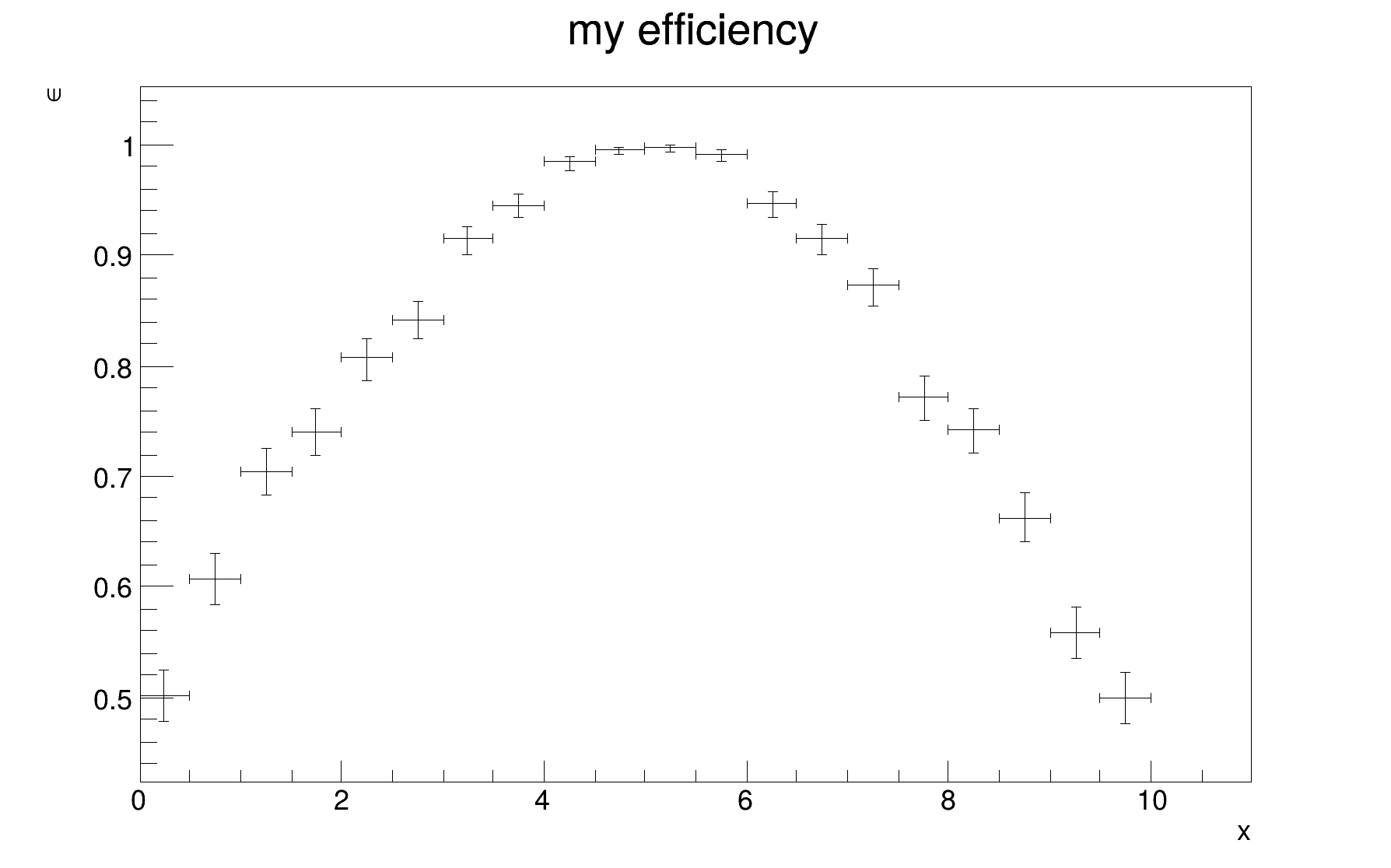
You can also set the number of passed or total events for a bin directly by using the TEfficiency::SetPassedEvents or TEfficiency::SetTotalEvents method.
The calculation of the estimated efficiency depends on the chosen statistic option. Let k denotes the number of passed events and N the number of total events.
The expectation value of the number of passed events is given by the true efficiency times the total number of events. One can estimate the efficiency by replacing the expected number of passed events by the observed number of passed events.
\[ k = \epsilon \times N \Rightarrow \hat{\varepsilon} = \frac{k}{N} \]
In Bayesian statistics a likelihood-function (how probable is it to get the observed data assuming a true efficiency) and a prior probability (what is the probability that a certain true efficiency is actually realised) are used to determine a posterior probability by using Bayes theorem. At the moment, only beta distributions (with 2 free parameters) are supported as prior probabilities, as explained in D. Casadei, Estimating the selection efficiency, 2012 JINST 7 P08021, https://doi.org/10.1088/1748-0221/7/08/P08021 (https://arxiv.org/abs/0908.0130).
\begin{eqnarray*} P(\epsilon | k ; N) &=& \frac{1}{norm} \times P(k | \epsilon ; N) \times Prior(\epsilon) \\ P(k | \epsilon ; N) &=& Binomial(N,k) \times \epsilon^{k} \times (1 - \epsilon)^{N - k} ...\ binomial\ distribution \\ Prior(\epsilon) &=& \frac{1}{B(\alpha,\beta)} \times \epsilon ^{\alpha - 1} \times (1 - \epsilon)^{\beta - 1} \equiv Beta(\epsilon; \alpha,\beta) \\ \Rightarrow P(\epsilon | k ; N) &=& \frac{1}{norm'} \times \epsilon^{k + \alpha - 1} \times (1 - \epsilon)^{N - k + \beta - 1} \equiv Beta(\epsilon; k + \alpha, N - k + \beta) \end{eqnarray*}
By default the expectation value of this posterior distribution is used as an estimator for the efficiency:
\[ \hat{\varepsilon} = \frac{k + \alpha}{N + \alpha + \beta} \]
Optionally the mode can also be used as a value for the estimated efficiency. This can be done by calling SetBit(kPosteriorMode) or TEfficiency::SetPosteriorMode. In this case, the estimated efficiency is:
\[ \hat{\varepsilon} = \frac{k + \alpha -1}{N + \alpha + \beta - 2} \]
In the case of a uniform prior distribution, B(x,1,1), the posterior mode is k/n, equivalent to the frequentist estimate (the maximum likelihood value).
The statistic options also specify which confidence interval is used for calculating the uncertainties of the efficiency. The following properties define the error calculation:
In the following table, the implemented confidence intervals are listed with their corresponding statistic option. For more details on the calculation, please have a look at the mentioned functions.
| name | statistic option | function | kIsBayesian | parameters |
|---|---|---|---|---|
| Clopper-Pearson | kFCP | TEfficiency::ClopperPearson | false | total events, passed events, confidence level |
| normal approximation | kFNormal | TEfficiency::Normal | false | total events, passed events, confidence level |
| Wilson | kFWilson | TEfficiency::Wilson | false | total events, passed events, confidence level |
| Agresti-Coull | kFAC | TEfficiency::AgrestiCoull | false | total events, passed events. confidence level |
| Feldman-Cousins | kFFC | TEfficiency::FeldmanCousins | false | total events, passed events, confidence level |
| Mid-P Lancaster | kMidP | TEfficiency::MidPInterval | false | total events, passed events, confidence level |
| Jeffrey | kBJeffrey | TEfficiency::Bayesian | true | total events, passed events, confidence level, fBeta_alpha = 0.5, fBeta_beta = 0.5 |
| Uniform prior | kBUniform | TEfficiency::Bayesian | true | total events, passed events, confidence level, fBeta_alpha = 1, fBeta_beta = 1 |
| custom prior | kBBayesian | TEfficiency::Bayesian | true | total events, passed events, confidence level, fBeta_alpha, fBeta_beta |
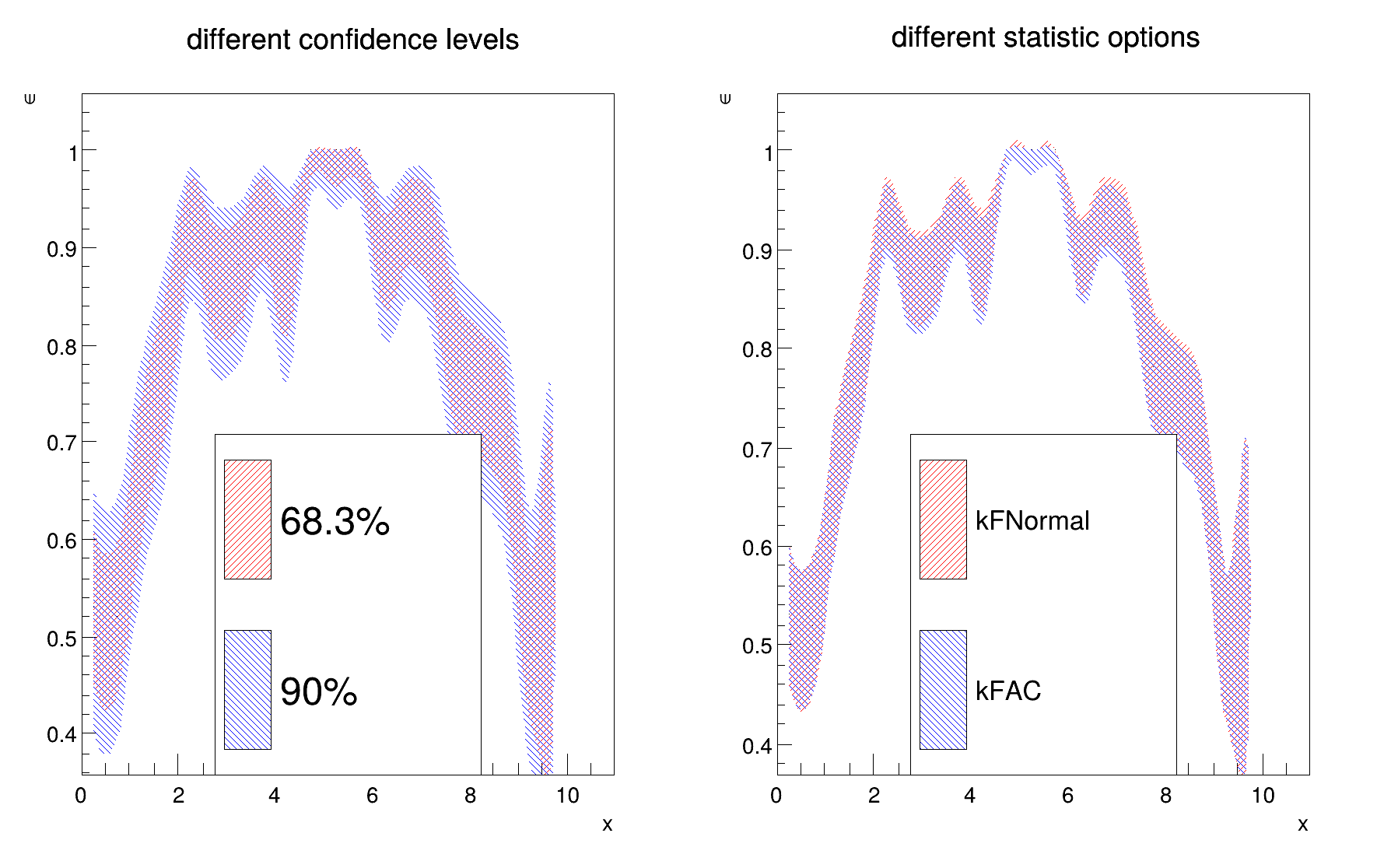
The following example demonstrates the effect of different statistic options and confidence levels.
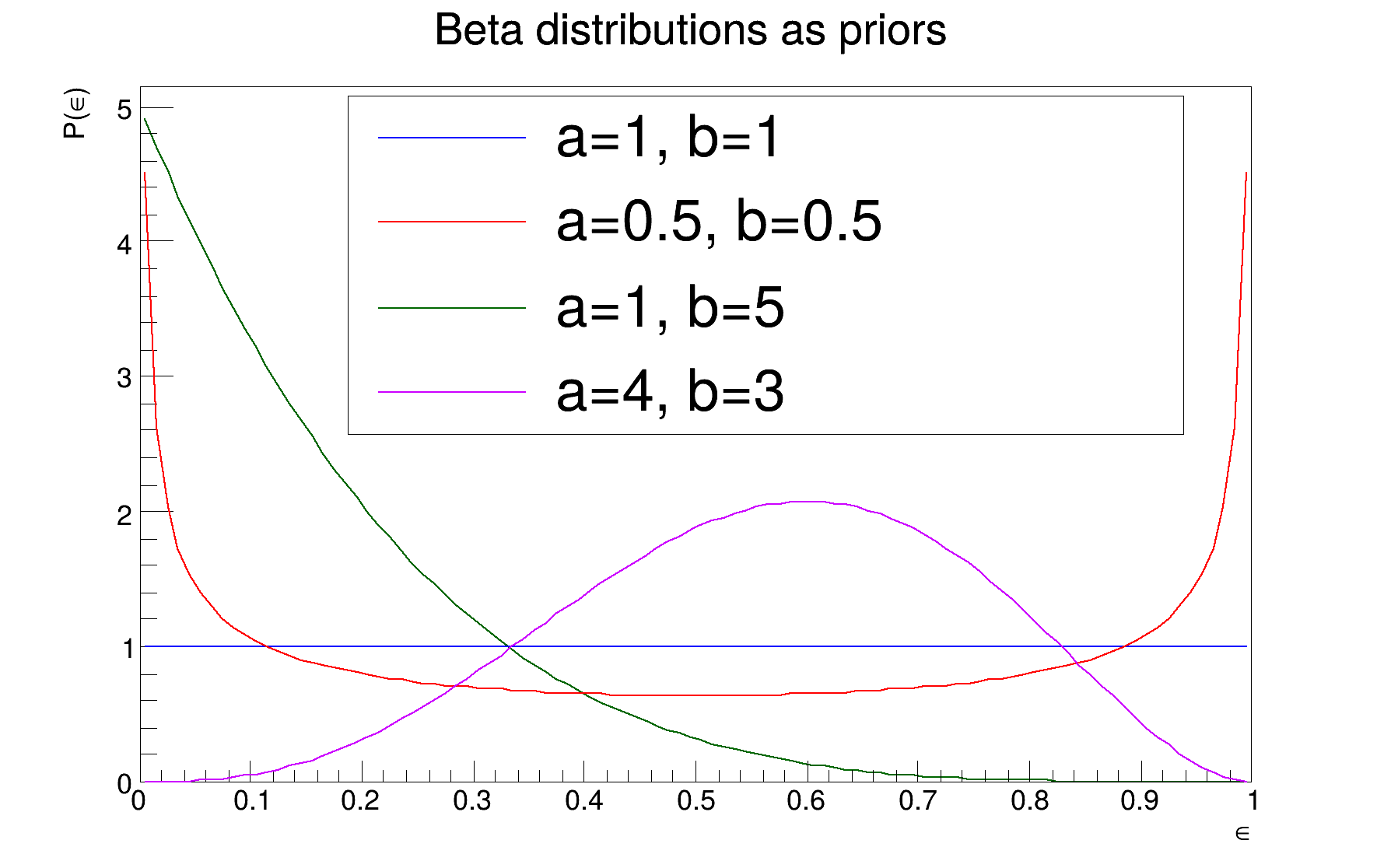
The prior probability of the efficiency in Bayesian statistics can be given in terms of a beta distribution. The beta distribution has two positive shape parameters. The resulting priors for different combinations of these shape parameters are shown in the plot below.
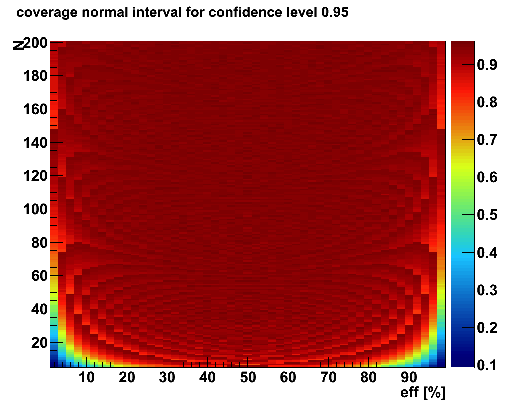
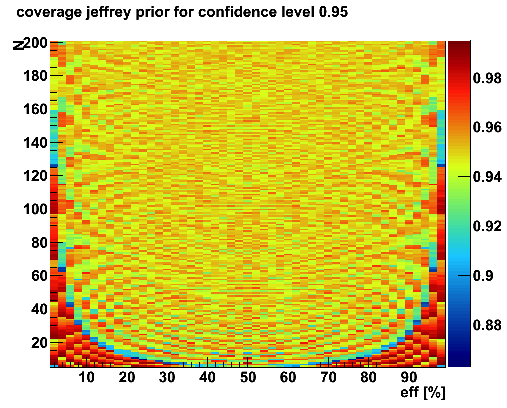
The following pictures illustrate the actual coverage probability for the different values of the true efficiency and the total number of events when a confidence level of 95% is desired.
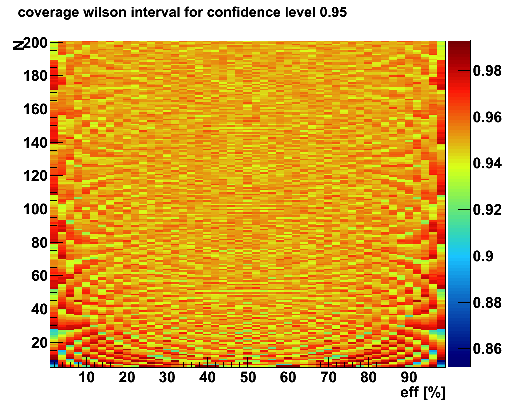
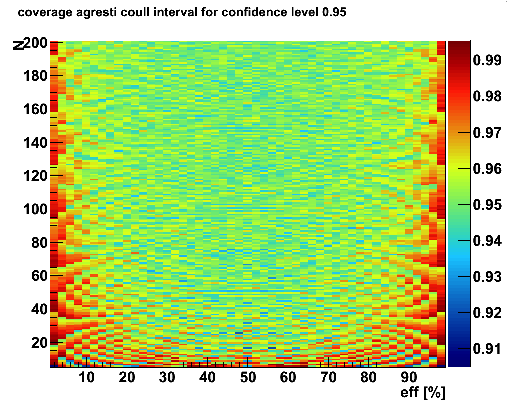
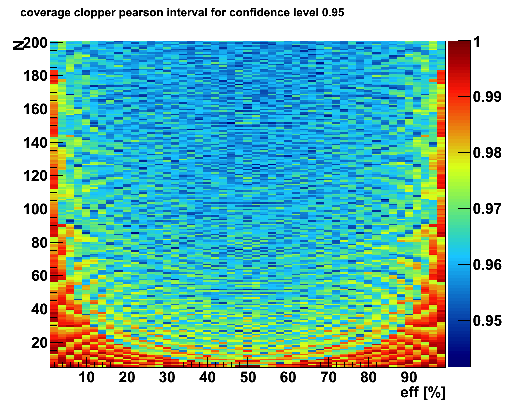
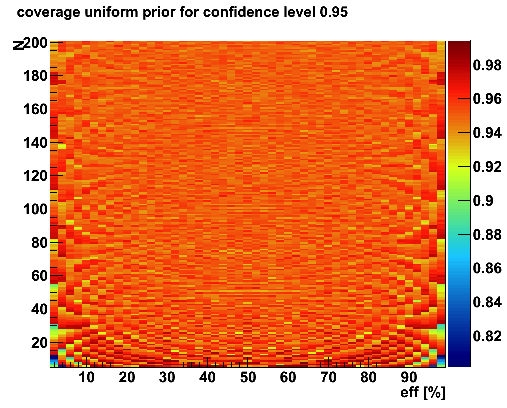
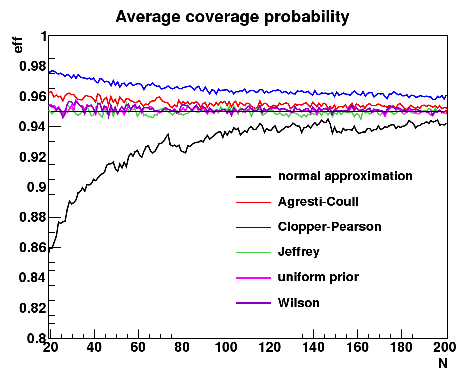
The average (over all possible true efficiencies) coverage probability for different number of total events is shown in the next picture.
In many applications, the efficiency should be calculated for an inhomogeneous sample in the sense that it contains events with different weights. In order to be able to determine the correct overall efficiency, it is necessary to use for each subsample (= all events with the same weight) a different TEfficiency object. After finishing your analysis you can then construct the overall efficiency with its uncertainty.
This procedure has the advantage that you can change the weight of one subsample easily without rerunning the whole analysis. On the other hand, more effort is needed to handle several TEfficiency objects instead of one histogram. In the case of many different or even continuously distributed weights, this approach becomes cumbersome. One possibility to overcome this problem is the usage of binned weights.
In particle physics weights arises from the fact that you want to normalise your results to a certain reference value. A very common formula for calculating weights is
\begin{eqnarray*} w &=& \frac{\sigma L}{N_{gen} \epsilon_{trig}} \\ &-& \sigma ...\ cross\ section \\ &-& L ...\ luminosity \\ &-& N_{gen}\ ... number\ of\ generated\ events \\ &-& \epsilon_{trig}\ ...\ (known)\ trigger\ efficiency \\ \end{eqnarray*}
The reason for different weights can therefore be:
Depending on the actual meaning of different weights in your case, you should either merge or combine them to get the overall efficiency.
If the weights are artificial and do not represent real alternative hypotheses, you should merge the different TEfficiency objects. That means especially for the Bayesian case that the prior probability should be the same for all merged TEfficiency objects. The merging can be done by invoking one of the following operations:
The result of the merging is stored in the TEfficiency object which is marked bold above. The contents of the internal histograms of both TEfficiency objects are added and a new weight is assigned. The statistic options are not changed.
\[ \frac{1}{w_{new}} = \frac{1}{w_{1}} + \frac{1}{w_{2}} \]
If you use two samples with different numbers of generated events for the same process and you want to normalise both to the same integrated luminosity and trigger efficiency, the different weights then arise just from the fact that you have different numbers of events. The TEfficiency objects should be merged because the samples do not represent true alternatives. You expect the same result as if you would have a big sample with all events in it.
\[ w_{1} = \frac{\sigma L}{\epsilon N_{1}}, w_{2} = \frac{\sigma L}{\epsilon N_{2}} \Rightarrow w_{new} = \frac{\sigma L}{\epsilon (N_{1} + N_{2})} = \frac{1}{\frac{1}{w_{1}} + \frac{1}{w_{2}}} \]
You should combine TEfficiency objects whenever the weights represent alternatives processes for the efficiency. As the combination of two TEfficiency objects is not always consistent with the representation by two internal histograms, the result is not stored in a TEfficiency object but a TGraphAsymmErrors is returned which shows the estimated combined efficiency and its uncertainty for each bin. At the moment the combination method TEfficiency::Combine only supports a combination of 1-dimensional efficiencies in a Bayesian approach.
For calculating the combined efficiency and its uncertainty for each bin only Bayesian statistics is used. No frequentists methods are presently supported for computing the combined efficiency and its confidence interval. In the case of the Bayesian statistics, a combined posterior is constructed taking into account the weight of each TEfficiency object. The same prior is used for all the TEfficiency objects.
\begin{eqnarray*} P_{comb}(\epsilon | {w_{i}}, {k_{i}} , {N_{i}}) = \frac{1}{norm} \prod_{i}{L(k_{i} | N_{i}, \epsilon)}^{w_{i}} \Pi( \epsilon )\\ L(k_{i} | N_{i}, \epsilon)\ is\ the\ likelihood\ function\ for\ the\ sample\ i\ (a\ Binomial\ distribution)\\ \Pi( \epsilon)\ is\ the\ prior,\ a\ beta\ distribution\ B(\epsilon, \alpha, \beta).\\ The\ resulting\ combined\ posterior\ is \\ P_{comb}(\epsilon |{w_{i}}; {k_{i}}; {N_{i}}) = B(\epsilon, \sum_{i}{ w_{i} k_{i}} + \alpha, \sum_{i}{ w_{i}(n_{i}-k_{i})}+\beta) \\ \hat{\varepsilon} = \int_{0}^{1} \epsilon \times P_{comb}(\epsilon | {k_{i}} , {N_{i}}) d\epsilon \\ confidence\ level = 1 - \alpha \\ \frac{\alpha}{2} = \int_{0}^{\epsilon_{low}} P_{comb}(\epsilon | {k_{i}} , {N_{i}}) d\epsilon ...\ defines\ lower\ boundary \\ 1- \frac{\alpha}{2} = \int_{0}^{\epsilon_{up}} P_{comb}(\epsilon | {k_{i}} , {N_{i}}) d\epsilon ...\ defines\ upper\ boundary \end{eqnarray*}
If you use cuts to select electrons which can originate from two different processes, you can determine the selection efficiency for each process. The overall selection efficiency is then the combined efficiency. The weights to be used in the combination should be the probability that an electron comes from the corresponding process.
\[ p_{1} = \frac{\sigma_{1}}{\sigma_{1} + \sigma_{2}} = \frac{N_{1}w_{1}}{N_{1}w_{1} + N_{2}w_{2}}\\ p_{2} = \frac{\sigma_{2}}{\sigma_{1} + \sigma_{2}} = \frac{N_{2}w_{2}}{N_{1}w_{1} + N_{2}w_{2}} \]
The methods TEfficiency::GetPassedHistogram and TEfficiency::GetTotalHistogram return a constant pointer to the internal histograms. They can be used to obtain information about the internal histograms (e.g., the binning, number of passed / total events in a bin, mean values...). One can obtain a clone of the internal histograms by calling TEfficiency::GetCopyPassedHisto or TEfficiency::GetCopyTotalHisto. The returned histograms are completely independent from the current TEfficiency object. By default, they are not attached to a directory to avoid the duplication of data and the user is responsible for deleting them.
It is also possible to set the internal total or passed histogram by using the methods TEfficiency::SetPassedHistogram or TEfficiency::SetTotalHistogram.
In order to ensure the validity of the TEfficiency object, the consistency of the new histogram and the stored histogram is checked. It might be impossible sometimes to change the histograms in a consistent way. Therefore one can force the replacement by passing the "f" option. Then the user has to ensure that the other internal histogram is replaced as well and that the TEfficiency object is in a valid state.
The efficiency can be fitted using the TEfficiency::Fit function which internally uses the TBinomialEfficiencyFitter::Fit method. As this method is using a maximum-likelihood-fit, it is necessary to initialise the given fit function with reasonable start values. The resulting fit function is attached to the list of associated functions and will be drawn automatically during the next TEfficiency::Draw command. The list of associated function can be modified by using the pointer returned by TEfficiency::GetListOfFunctions.
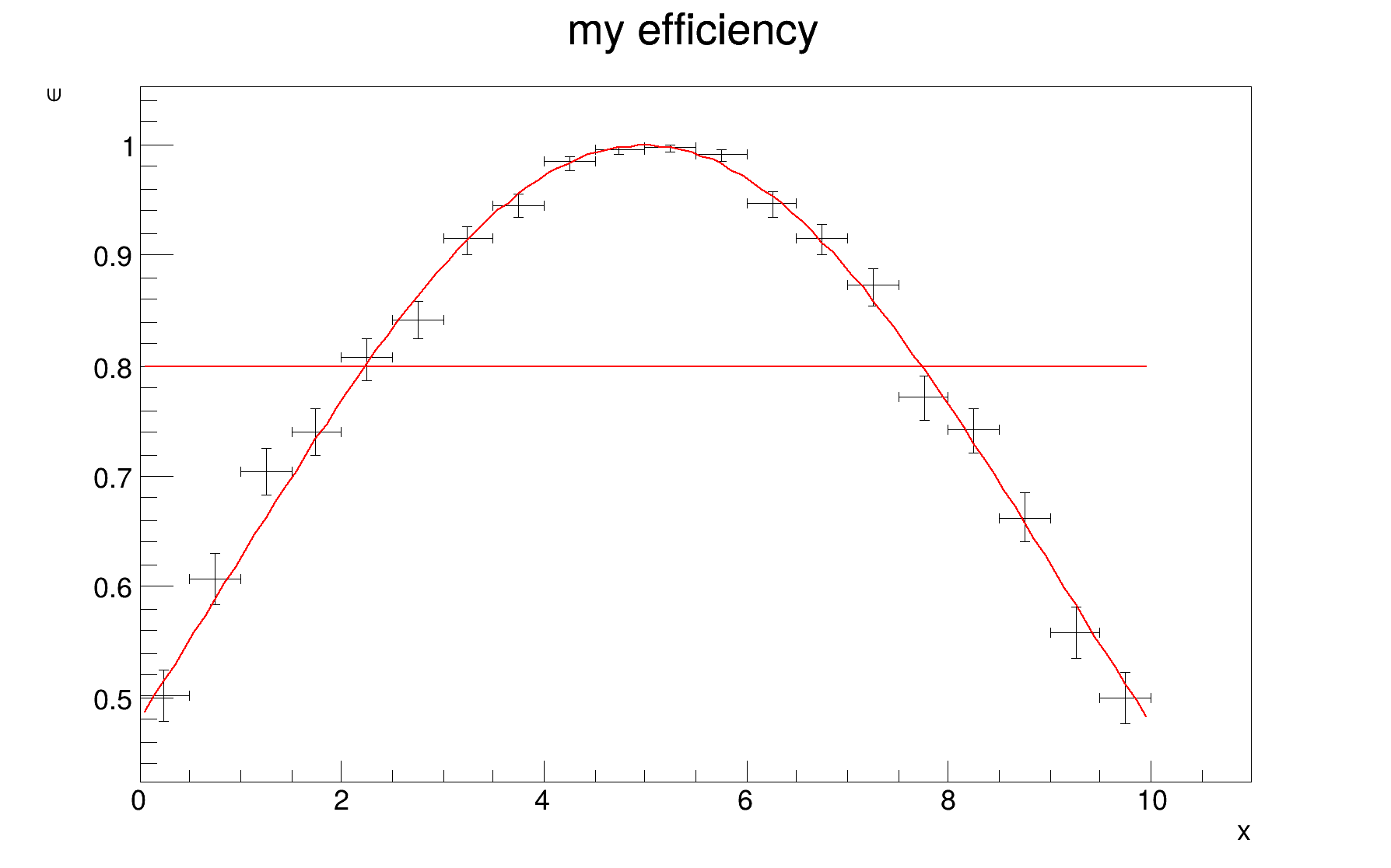
A TEfficiency object can be drawn by calling the usual TEfficiency::Draw method. At the moment drawing is only supported for 1- and 2-dimensional TEfficiency objects. In the 1-dimensional case, you can use the same options as for the TGraphAsymmErrors::Draw method. For 2-dimensional TEfficiency objects, you can pass the same options as for a TH2::Draw object.
The axes of a TEfficiency object can be accessed and customised by calling the GetPaintedGraph method and then GetXaxis() or GetYaxis() and the corresponding TAxis methods. Note that in order to access the painted graph via GetPaintedGraph(), one should either call Paint or, better, gPad->Update().
Definition at line 28 of file TEfficiency.h.
Public Types | |
| enum | { kPreferTriangles = (1ULL << ( 0 )) , kDotAsLines = (1ULL << ( 1 )) , kDotAsCircle = (1ULL << ( 2 )) , kUsePSWidthScale = (1ULL << ( 3 )) } |
| enum | { kIsOnHeap = 0x01000000 , kNotDeleted = 0x02000000 , kZombie = 0x04000000 , kInconsistent = 0x08000000 , kBitMask = 0x00ffffff } |
| enum | { kSingleKey = (1ULL << ( 0 )) , kOverwrite = (1ULL << ( 1 )) , kWriteDelete = (1ULL << ( 2 )) } |
| enum | EDeprecatedStatusBits { kObjInCanvas = (1ULL << ( 3 )) } |
| enum | EMarkerShape { kShapeDot , kShapeCircle , kShapeFilledCircle , kShapePolyLine , kShapeFilledArea , kShapeSegments , kShapeTriangles } |
| enum | EStatOption { kFCP = 0 , kFNormal , kFWilson , kFAC , kFFC , kBJeffrey , kBUniform , kBBayesian , kMidP } |
| Enumeration type for different statistic options for calculating confidence intervals kF* ... frequentist methods; kB* ... bayesian methods. More... | |
Public Member Functions | |
| TEfficiency () | |
| Default constructor. | |
| TEfficiency (const char *name, const char *title, Int_t nbins, const Double_t *xbins) | |
| Create 1-dimensional TEfficiency object with variable bin size. | |
| TEfficiency (const char *name, const char *title, Int_t nbins, Double_t xlow, Double_t xup) | |
| Create 1-dimensional TEfficiency object with fixed bins size. | |
| TEfficiency (const char *name, const char *title, Int_t nbinsx, const Double_t *xbins, Int_t nbinsy, const Double_t *ybins) | |
| Create 2-dimensional TEfficiency object with variable bin size. | |
| TEfficiency (const char *name, const char *title, Int_t nbinsx, const Double_t *xbins, Int_t nbinsy, const Double_t *ybins, Int_t nbinsz, const Double_t *zbins) | |
| Create 3-dimensional TEfficiency object with variable bin size. | |
| TEfficiency (const char *name, const char *title, Int_t nbinsx, Double_t xlow, Double_t xup, Int_t nbinsy, Double_t ylow, Double_t yup) | |
| Create 2-dimensional TEfficiency object with fixed bin size. | |
| TEfficiency (const char *name, const char *title, Int_t nbinsx, Double_t xlow, Double_t xup, Int_t nbinsy, Double_t ylow, Double_t yup, Int_t nbinsz, Double_t zlow, Double_t zup) | |
| Create 3-dimensional TEfficiency object with fixed bin size. | |
| TEfficiency (const TEfficiency &heff) | |
| Copy constructor. | |
| TEfficiency (const TH1 &passed, const TH1 &total) | |
| Constructor using two existing histograms as input. | |
| ~TEfficiency () override | |
| default destructor | |
| void | AbstractMethod (const char *method) const |
| Call this function within a function that you don't want to define as purely virtual, in order not to force all users deriving from that class to implement that maybe (on their side) unused function; but at the same time, emit a run-time warning if they try to call it, telling that it is not implemented in the derived class: action must thus be taken on the user side to override it. | |
| void | Add (const TEfficiency &rEff) |
| virtual void | AppendPad (Option_t *option="") |
| Append graphics object to current pad. | |
| void | Browse (TBrowser *) override |
| Browse object. May be overridden for another default action. | |
| ULong_t | CheckedHash () |
| Check and record whether this class has a consistent Hash/RecursiveRemove setup (*) and then return the regular Hash value for this object. | |
| virtual const char * | ClassName () const |
| Returns name of class to which the object belongs. | |
| void | Clear (Option_t *option="") override |
| Set name and title to empty strings (""). | |
| TObject * | Clone (const char *newname="") const override |
| Make a clone of an object using the Streamer facility. | |
| Int_t | Compare (const TObject *obj) const override |
| Compare two TNamed objects. | |
| void | Copy (TAttFill &attfill) const |
| Copy this fill attributes to a new TAttFill. | |
| void | Copy (TAttLine &attline) const |
| Copy this line attributes to a new TAttLine. | |
| void | Copy (TAttMarker &attmarker) const |
| Copy this marker attributes to a new TAttMarker. | |
| void | Copy (TObject &named) const override |
| Copy this to obj. | |
| TGraphAsymmErrors * | CreateGraph (Option_t *opt="") const |
| Create the graph used be painted (for dim=1 TEfficiency) The return object is managed by the caller. | |
| TGraph2DAsymmErrors * | CreateGraph2D (Option_t *opt="") const |
| Create the graph used be painted (for dim=1 TEfficiency) The return object is managed by the caller. | |
| TH2 * | CreateHistogram (Option_t *opt="") const |
| Create the histogram used to be painted (for dim=2 TEfficiency) The return object is managed by the caller. | |
| virtual void | Delete (Option_t *option="") |
| Delete this object. | |
| Int_t | DistancetoLine (Int_t px, Int_t py, Double_t xp1, Double_t yp1, Double_t xp2, Double_t yp2) |
| Compute distance from point px,py to a line. | |
| Int_t | DistancetoPrimitive (Int_t px, Int_t py) override |
| Compute distance from point px,py to a graph. | |
| void | Draw (Option_t *opt="") override |
| Draws the current TEfficiency object. | |
| virtual void | DrawClass () const |
| Draw class inheritance tree of the class to which this object belongs. | |
| virtual TObject * | DrawClone (Option_t *option="") const |
Draw a clone of this object in the current selected pad with: gROOT->SetSelectedPad(c1). | |
| virtual void | Dump () const |
| Dump contents of object on stdout. | |
| virtual void | Error (const char *method, const char *msgfmt,...) const |
| Issue error message. | |
| virtual void | Execute (const char *method, const char *params, Int_t *error=nullptr) |
| Execute method on this object with the given parameter string, e.g. | |
| virtual void | Execute (TMethod *method, TObjArray *params, Int_t *error=nullptr) |
| Execute method on this object with parameters stored in the TObjArray. | |
| void | ExecuteEvent (Int_t event, Int_t px, Int_t py) override |
| Execute action corresponding to one event. | |
| virtual void | Fatal (const char *method, const char *msgfmt,...) const |
| Issue fatal error message. | |
| void | Fill (Bool_t bPassed, Double_t x, Double_t y=0, Double_t z=0) |
| This function is used for filling the two histograms. | |
| virtual void | FillBuffer (char *&buffer) |
| Encode TNamed into output buffer. | |
| void | FillWeighted (Bool_t bPassed, Double_t weight, Double_t x, Double_t y=0, Double_t z=0) |
| This function is used for filling the two histograms with a weight. | |
| Int_t | FindFixBin (Double_t x, Double_t y=0, Double_t z=0) const |
| Returns the global bin number containing the given values. | |
| virtual TObject * | FindObject (const char *name) const |
| Must be redefined in derived classes. | |
| virtual TObject * | FindObject (const TObject *obj) const |
| Must be redefined in derived classes. | |
| TFitResultPtr | Fit (TF1 *f1, Option_t *opt="") |
| Fits the efficiency using the TBinomialEfficiencyFitter class. | |
| Double_t | GetBetaAlpha (Int_t bin=-1) const |
| Double_t | GetBetaBeta (Int_t bin=-1) const |
| Double_t | GetConfidenceLevel () const |
| TH1 * | GetCopyPassedHisto () const |
| Returns a cloned version of fPassedHistogram. | |
| TH1 * | GetCopyTotalHisto () const |
| Returns a cloned version of fTotalHistogram. | |
| Int_t | GetDimension () const |
| returns the dimension of the current TEfficiency object | |
| TDirectory * | GetDirectory () const |
| virtual Option_t * | GetDrawOption () const |
| Get option used by the graphics system to draw this object. | |
| Double_t | GetEfficiency (Int_t bin) const |
| Returns the efficiency in the given global bin. | |
| Double_t | GetEfficiencyErrorLow (Int_t bin) const |
| Returns the lower error on the efficiency in the given global bin. | |
| Double_t | GetEfficiencyErrorUp (Int_t bin) const |
| Returns the upper error on the efficiency in the given global bin. | |
| virtual Color_t | GetFillColor () const |
| Return the fill area color. | |
| virtual Style_t | GetFillStyle () const |
| Return the fill area style. | |
| Int_t | GetGlobalBin (Int_t binx, Int_t biny=0, Int_t binz=0) const |
| Returns the global bin number which can be used as argument for the following functions: | |
| virtual const char * | GetIconName () const |
| Returns mime type name of object. | |
| virtual Color_t | GetLineColor () const |
| Return the line color. | |
| virtual Style_t | GetLineStyle () const |
| Return the line style. | |
| virtual Width_t | GetLineWidth () const |
| Return the line width. | |
| TList * | GetListOfFunctions () |
| virtual Color_t | GetMarkerColor () const |
| Return the marker color. | |
| EMarkerShape | GetMarkerShape (Int_t &sz, std::vector< TPoint > &points, Float_t scale=1., UInt_t flags=0) const |
| Return marker shape. | |
| virtual Size_t | GetMarkerSize () const |
| Return the marker size. | |
| virtual Style_t | GetMarkerStyle () const |
| Return the marker style. | |
| const char * | GetName () const override |
| Returns name of object. | |
| virtual char * | GetObjectInfo (Int_t px, Int_t py) const |
| Returns string containing info about the object at position (px,py). | |
| virtual Option_t * | GetOption () const |
| TGraphAsymmErrors * | GetPaintedGraph () const |
| TGraph2DAsymmErrors * | GetPaintedGraph2D () const |
| TH2 * | GetPaintedHistogram () const |
| const TH1 * | GetPassedHistogram () const |
| EStatOption | GetStatisticOption () const |
| const char * | GetTitle () const override |
| Returns title of object. | |
| const TH1 * | GetTotalHistogram () const |
| virtual UInt_t | GetUniqueID () const |
| Return the unique object id. | |
| Double_t | GetWeight () const |
| virtual Bool_t | HandleTimer (TTimer *timer) |
| Execute action in response of a timer timing out. | |
| ULong_t | Hash () const override |
| Return hash value for this object. | |
| Bool_t | HasInconsistentHash () const |
| Return true is the type of this object is known to have an inconsistent setup for Hash and RecursiveRemove (i.e. | |
| virtual void | Info (const char *method, const char *msgfmt,...) const |
| Issue info message. | |
| virtual Bool_t | InheritsFrom (const char *classname) const |
| Returns kTRUE if object inherits from class "classname". | |
| virtual Bool_t | InheritsFrom (const TClass *cl) const |
| Returns kTRUE if object inherits from TClass cl. | |
| virtual void | Inspect () const |
| Dump contents of this object in a graphics canvas. | |
| void | InvertBit (UInt_t f) |
| TClass * | IsA () const override |
| Bool_t | IsDestructed () const |
| IsDestructed. | |
| virtual Bool_t | IsEqual (const TObject *obj) const |
| Default equal comparison (objects are equal if they have the same address in memory). | |
| virtual Bool_t | IsFolder () const |
| Returns kTRUE in case object contains browsable objects (like containers or lists of other objects). | |
| R__ALWAYS_INLINE Bool_t | IsOnHeap () const |
| Bool_t | IsSortable () const override |
| virtual Bool_t | IsTransparent () const |
| R__ALWAYS_INLINE Bool_t | IsZombie () const |
| void | ls (Option_t *option="") const override |
| List TNamed name and title. | |
| void | MayNotUse (const char *method) const |
| Use this method to signal that a method (defined in a base class) may not be called in a derived class (in principle against good design since a child class should not provide less functionality than its parent, however, sometimes it is necessary). | |
| Long64_t | Merge (TCollection *list) |
| Merges the TEfficiency objects in the given list to the given TEfficiency object using the operator+=(TEfficiency&) | |
| virtual void | Modify () |
| Change current fill area attributes if necessary. | |
| virtual void | Modify () |
| Change current line attributes if necessary. | |
| virtual void | Modify () |
| Change current marker attributes if necessary. | |
| virtual void | ModifyOn (TVirtualPad &pad) |
| Change current fill area attributes on speicifed pad. | |
| virtual void | ModifyOn (TVirtualPad &pad) |
| Change current line attributes on specified pad. | |
| virtual void | ModifyOn (TVirtualPad &pad) |
| Change current marker attributes if necessary on specified pad. | |
| virtual Bool_t | Notify () |
| This method must be overridden to handle object notification (the base implementation is no-op). | |
| void | Obsolete (const char *method, const char *asOfVers, const char *removedFromVers) const |
| Use this method to declare a method obsolete. | |
| void | operator delete (void *, size_t) |
| Operator delete for sized deallocation. | |
| void | operator delete (void *ptr) |
| Operator delete. | |
| void | operator delete (void *ptr, void *vp) |
| Only called by placement new when throwing an exception. | |
| void | operator delete[] (void *, size_t) |
| Operator delete [] for sized deallocation. | |
| void | operator delete[] (void *ptr) |
| Operator delete []. | |
| void | operator delete[] (void *ptr, void *vp) |
| Only called by placement new[] when throwing an exception. | |
| void * | operator new (size_t sz) |
| void * | operator new (size_t sz, void *vp) |
| void * | operator new[] (size_t sz) |
| void * | operator new[] (size_t sz, void *vp) |
| TEfficiency & | operator+= (const TEfficiency &rhs) |
| Adds the histograms of another TEfficiency object to current histograms. | |
| TEfficiency & | operator= (const TEfficiency &rhs) |
| Assignment operator. | |
| void | Paint (Option_t *opt) override |
| Paints this TEfficiency object. | |
| virtual void | Pop () |
| Pop on object drawn in a pad to the top of the display list. | |
| void | Print (Option_t *option="") const override |
| Print TNamed name and title. | |
| virtual Int_t | Read (const char *name) |
| Read contents of object with specified name from the current directory. | |
| void | RecursiveRemove (TObject *obj) override |
| Recursively remove object from the list of functions. | |
| virtual void | ResetAttFill (Option_t *option="") |
| Reset this fill attributes to default values. | |
| virtual void | ResetAttLine (Option_t *option="") |
| Reset this line attributes to default values. | |
| virtual void | ResetAttMarker (Option_t *toption="") |
| Reset this marker attributes to the default values. | |
| void | ResetBit (UInt_t f) |
| virtual void | SaveAs (const char *filename="", Option_t *option="") const |
| Save this object in the file specified by filename. | |
| virtual void | SaveFillAttributes (std::ostream &out, const char *name, Int_t coldef=1, Int_t stydef=1001) |
| Save fill attributes as C++ statement(s) on output stream out. | |
| virtual void | SaveLineAttributes (std::ostream &out, const char *name, Int_t coldef=1, Int_t stydef=1, Int_t widdef=1) |
| Save line attributes as C++ statement(s) on output stream out. | |
| virtual void | SaveMarkerAttributes (std::ostream &out, const char *name, Int_t coldef=1, Int_t stydef=1, Int_t sizdef=1) |
| Save line attributes as C++ statement(s) on output stream out. | |
| void | SavePrimitive (std::ostream &out, Option_t *opt="") override |
| Save primitive as a C++ statement(s) on output stream out. | |
| void | SetBetaAlpha (Double_t alpha) |
| Sets the shape parameter α. | |
| void | SetBetaBeta (Double_t beta) |
| Sets the shape parameter β. | |
| void | SetBetaBinParameters (Int_t bin, Double_t alpha, Double_t beta) |
| Sets different shape parameter α and β for the prior distribution for each bin. | |
| Bool_t | SetBins (Int_t nx, const Double_t *xBins) |
| Set the bins for the underlined passed and total histograms If the class have been already filled the previous contents will be lost. | |
| Bool_t | SetBins (Int_t nx, const Double_t *xBins, Int_t ny, const Double_t *yBins) |
| Set the bins for the underlined passed and total histograms If the class have been already filled the previous contents will be lost. | |
| Bool_t | SetBins (Int_t nx, const Double_t *xBins, Int_t ny, const Double_t *yBins, Int_t nz, const Double_t *zBins) |
| Set the bins for the underlined passed and total histograms If the class have been already filled the previous contents will be lost. | |
| Bool_t | SetBins (Int_t nx, Double_t xmin, Double_t xmax) |
| Set the bins for the underlined passed and total histograms If the class have been already filled the previous contents will be lost. | |
| Bool_t | SetBins (Int_t nx, Double_t xmin, Double_t xmax, Int_t ny, Double_t ymin, Double_t ymax) |
| Set the bins for the underlined passed and total histograms If the class have been already filled the previous contents will be lost. | |
| Bool_t | SetBins (Int_t nx, Double_t xmin, Double_t xmax, Int_t ny, Double_t ymin, Double_t ymax, Int_t nz, Double_t zmin, Double_t zmax) |
| Set the bins for the underlined passed and total histograms If the class have been already filled the previous contents will be lost. | |
| void | SetBit (UInt_t f) |
| void | SetBit (UInt_t f, Bool_t set) |
| Set or unset the user status bits as specified in f. | |
| void | SetCentralInterval (Bool_t on=true) |
| void | SetConfidenceLevel (Double_t level) |
| Sets the confidence level (0 < level < 1) The default value is 1-sigma :~ 0.683. | |
| void | SetDirectory (TDirectory *dir) |
| Sets the directory holding this TEfficiency object. | |
| virtual void | SetDrawOption (Option_t *option="") |
| Set drawing option for object. | |
| virtual void | SetFillAttributes () |
| Invoke the DialogCanvas Fill attributes. | |
| virtual void | SetFillColor (Color_t fcolor) |
| Set the fill area color. | |
| void | SetFillColor (TColorNumber) |
| Set a fill color. | |
| virtual void | SetFillColorAlpha (Color_t fcolor, Float_t falpha) |
| Set a transparent fill color. | |
| virtual void | SetFillStyle (Style_t fstyle) |
| Set the fill area style. | |
| virtual void | SetLineAttributes () |
| Invoke the DialogCanvas Line attributes. | |
| virtual void | SetLineColor (Color_t lcolor) |
| Set the line color. | |
| void | SetLineColor (TColorNumber lcolor) |
| virtual void | SetLineColorAlpha (Color_t lcolor, Float_t lalpha) |
| Set a transparent line color. | |
| virtual void | SetLineStyle (Style_t lstyle) |
| Set the line style. | |
| virtual void | SetLineWidth (Width_t lwidth) |
| Set the line width. | |
| virtual void | SetMarkerAttributes () |
| Invoke the DialogCanvas Marker attributes. | |
| virtual void | SetMarkerColor (Color_t mcolor=1) |
| Set the marker color. | |
| void | SetMarkerColor (TColorNumber lcolor) |
| Set the marker color. | |
| virtual void | SetMarkerColorAlpha (Color_t mcolor, Float_t malpha) |
| Set a transparent marker color. | |
| virtual void | SetMarkerSize (Size_t msize=1) |
| Set the marker size. | |
| virtual void | SetMarkerStyle (Style_t mstyle=1) |
| Set the marker style. | |
| void | SetName (const char *name) override |
| Sets the name. | |
| virtual void | SetNameTitle (const char *name, const char *title) |
| Set all the TNamed parameters (name and title). | |
| Bool_t | SetPassedEvents (Int_t bin, Double_t events) |
| Sets the number of passed events in the given global bin. | |
| Bool_t | SetPassedHistogram (const TH1 &rPassed, Option_t *opt) |
| Sets the histogram containing the passed events. | |
| void | SetPosteriorAverage (Bool_t on=true) |
| void | SetPosteriorMode (Bool_t on=true) |
| void | SetShortestInterval (Bool_t on=true) |
| void | SetStatisticOption (EStatOption option) |
| Sets the statistic option which affects the calculation of the confidence interval. | |
| void | SetTitle (const char *title) override |
| Sets the title. | |
| Bool_t | SetTotalEvents (Int_t bin, Double_t events) |
| Sets the number of total events in the given global bin. | |
| Bool_t | SetTotalHistogram (const TH1 &rTotal, Option_t *opt) |
| Sets the histogram containing all events. | |
| virtual void | SetUniqueID (UInt_t uid) |
| Set the unique object id. | |
| void | SetUseWeightedEvents (Bool_t on=kTRUE) |
| void | SetWeight (Double_t weight) |
| Sets the global weight for this TEfficiency object. | |
| virtual Int_t | Sizeof () const |
| Return size of the TNamed part of the TObject. | |
| void | Streamer (TBuffer &) override |
| Stream an object of class TObject. | |
| void | StreamerNVirtual (TBuffer &ClassDef_StreamerNVirtual_b) |
| virtual void | SysError (const char *method, const char *msgfmt,...) const |
| Issue system error message. | |
| R__ALWAYS_INLINE Bool_t | TestBit (UInt_t f) const |
| Int_t | TestBits (UInt_t f) const |
| virtual void | UseCurrentStyle () |
| Set current style settings in this object This function is called when either TCanvas::UseCurrentStyle or TROOT::ForceStyle have been invoked. | |
| Bool_t | UsesBayesianStat () const |
| Bool_t | UsesCentralInterval () const |
| Bool_t | UsesPosteriorAverage () const |
| Bool_t | UsesPosteriorMode () const |
| Bool_t | UsesShortestInterval () const |
| Bool_t | UsesWeights () const |
| virtual void | Warning (const char *method, const char *msgfmt,...) const |
| Issue warning message. | |
| virtual Int_t | Write (const char *name=nullptr, Int_t option=0, Int_t bufsize=0) |
| Write this object to the current directory. | |
| virtual Int_t | Write (const char *name=nullptr, Int_t option=0, Int_t bufsize=0) const |
| Write this object to the current directory. | |
Static Public Member Functions | |
| static Double_t | AgrestiCoull (Double_t total, Double_t passed, Double_t level, Bool_t bUpper) |
| Calculates the boundaries for the frequentist Agresti-Coull interval. | |
| static Double_t | Bayesian (Double_t total, Double_t passed, Double_t level, Double_t alpha, Double_t beta, Bool_t bUpper, Bool_t bShortest=false) |
| Calculates the boundaries for a Bayesian confidence interval (shortest or central interval depending on the option) as explained in D. | |
| static Double_t | BetaCentralInterval (Double_t level, Double_t alpha, Double_t beta, Bool_t bUpper) |
| Calculates the boundaries for a central confidence interval for a Beta distribution. | |
| static Double_t | BetaMean (Double_t alpha, Double_t beta) |
| Compute the mean (average) of the beta distribution. | |
| static Double_t | BetaMode (Double_t alpha, Double_t beta) |
| Compute the mode of the beta distribution. | |
| static Bool_t | BetaShortestInterval (Double_t level, Double_t alpha, Double_t beta, Double_t &lower, Double_t &upper) |
| Calculates the boundaries for a shortest confidence interval for a Beta distribution. | |
| static Bool_t | CheckBinning (const TH1 &pass, const TH1 &total) |
| Checks binning for each axis. | |
| static Bool_t | CheckConsistency (const TH1 &pass, const TH1 &total, Option_t *opt="") |
| Checks the consistence of the given histograms. | |
| static Bool_t | CheckEntries (const TH1 &pass, const TH1 &total, Option_t *opt="") |
| Checks whether bin contents are compatible with binomial statistics. | |
| static Bool_t | CheckWeights (const TH1 &pass, const TH1 &total) |
| Check if both histogram are weighted. | |
| static TClass * | Class () |
| static const char * | Class_Name () |
| static constexpr Version_t | Class_Version () |
| static Double_t | ClopperPearson (Double_t total, Double_t passed, Double_t level, Bool_t bUpper) |
| Calculates the boundaries for the frequentist Clopper-Pearson interval. | |
| static Double_t | Combine (Double_t &up, Double_t &low, Int_t n, const Int_t *pass, const Int_t *total, Double_t alpha, Double_t beta, Double_t level=0.683, const Double_t *w=nullptr, Option_t *opt="") |
| static TGraphAsymmErrors * | Combine (TCollection *pList, Option_t *opt="", Int_t n=0, const Double_t *w=nullptr) |
| Combines a list of 1-dimensional TEfficiency objects. | |
| static const char * | DeclFileName () |
| static Double_t | FeldmanCousins (Double_t total, Double_t passed, Double_t level, Bool_t bUpper) |
| Calculates the boundaries for the frequentist Feldman-Cousins interval. | |
| static Bool_t | FeldmanCousinsInterval (Double_t total, Double_t passed, Double_t level, Double_t &lower, Double_t &upper) |
| Calculates the interval boundaries using the frequentist methods of Feldman-Cousins. | |
| static Longptr_t | GetDtorOnly () |
| Return destructor only flag. | |
| static Width_t | GetMarkerLineWidth (Style_t style) |
| Internal helper function that returns the line width of the given marker style (0 = filled marker) | |
| static Style_t | GetMarkerStyleBase (Style_t style) |
| Internal helper function that returns the corresponding marker style with line width 1 for the given style. | |
| static Bool_t | GetObjectStat () |
| Get status of object stat flag. | |
| static Double_t | MidPInterval (Double_t total, Double_t passed, Double_t level, Bool_t bUpper) |
| Calculates the boundaries using the mid-P binomial interval (Lancaster method) from B. | |
| static Double_t | Normal (Double_t total, Double_t passed, Double_t level, Bool_t bUpper) |
| Returns the confidence limits for the efficiency supposing that the efficiency follows a normal distribution with the rms below. | |
| static void | SetDtorOnly (void *obj) |
| Set destructor only flag. | |
| static void | SetObjectStat (Bool_t stat) |
| Turn on/off tracking of objects in the TObjectTable. | |
| static Double_t | Wilson (Double_t total, Double_t passed, Double_t level, Bool_t bUpper) |
| Calculates the boundaries for the frequentist Wilson interval. | |
Protected Types | |
| enum | { kOnlyPrepStep = (1ULL << ( 3 )) } |
| enum | EStatusBits { kIsBayesian = (1ULL << ( 14 )) , kPosteriorMode = (1ULL << ( 15 )) , kShortestInterval = (1ULL << ( 16 )) , kUseBinPrior = (1ULL << ( 17 )) , kUseWeights = (1ULL << ( 18 )) } |
Protected Member Functions | |
| void | Build (const char *name, const char *title) |
| Building standard data structure of a TEfficiency object. | |
| virtual void | DoError (int level, const char *location, const char *fmt, va_list va) const |
| Interface to ErrorHandler (protected). | |
| void | FillGraph (TGraphAsymmErrors *graph, Option_t *opt) const |
| Fill the graph to be painted with information from TEfficiency Internal method called by TEfficiency::Paint or TEfficiency::CreateGraph. | |
| void | FillGraph2D (TGraph2DAsymmErrors *graph, Option_t *opt) const |
| Fill the graph to be painted with information from TEfficiency Internal method called by TEfficiency::Paint or TEfficiency::CreateGraph. | |
| void | FillHistogram (TH2 *h2) const |
| Fill the 2d histogram to be painted with information from TEfficiency 2D Internal method called by TEfficiency::Paint or TEfficiency::CreatePaintingGraph. | |
| void | MakeZombie () |
| void | SavePrimitiveNameTitle (std::ostream &out, const char *variable_name) |
| Save object name and title into the output stream "out". | |
Static Protected Member Functions | |
| static void | SavePrimitiveConstructor (std::ostream &out, TClass *cl, const char *variable_name, const char *constructor_agrs="", Bool_t empty_line=kTRUE) |
| Save object constructor in the output stream "out". | |
| static void | SavePrimitiveDraw (std::ostream &out, const char *variable_name, Option_t *option=nullptr) |
| Save invocation of primitive Draw() method Skipped if option contains "nodraw" string. | |
| static TString | SavePrimitiveVector (std::ostream &out, const char *prefix, Int_t len, Double_t *arr, Int_t flag=0) |
| Save array in the output stream "out" as vector. | |
Protected Attributes | |
| Double_t | fBeta_alpha |
| Global parameter for prior beta distribution (default = 1) | |
| Double_t | fBeta_beta |
| Global parameter for prior beta distribution (default = 1) | |
| std::vector< std::pair< Double_t, Double_t > > | fBeta_bin_params |
| Parameter for prior beta distribution different bin by bin (default vector is empty) | |
| Double_t(* | fBoundary )(Double_t, Double_t, Double_t, Bool_t) |
| ! Pointer to a method calculating the boundaries of confidence intervals | |
| Double_t | fConfLevel |
| Confidence level (default = 0.683, 1 sigma) | |
| TDirectory * | fDirectory |
| ! Pointer to directory holding this TEfficiency object | |
| Color_t | fFillColor |
| Fill area color. | |
| Style_t | fFillStyle |
| Fill area style. | |
| TList * | fFunctions |
| ->Pointer to list of functions | |
| Color_t | fLineColor |
| Line color. | |
| Style_t | fLineStyle |
| Line style. | |
| Width_t | fLineWidth |
| Line width. | |
| Color_t | fMarkerColor |
| Marker color. | |
| Size_t | fMarkerSize |
| Marker size. | |
| Style_t | fMarkerStyle |
| Marker style. | |
| TString | fName |
| TGraphAsymmErrors * | fPaintGraph =nullptr |
| ! Temporary graph for painting | |
| TGraph2DAsymmErrors * | fPaintGraph2D =nullptr |
| ! Temporary graph for painting | |
| TH2 * | fPaintHisto =nullptr |
| ! Temporary histogram for painting | |
| TH1 * | fPassedHistogram |
| Histogram for events which passed certain criteria. | |
| EStatOption | fStatisticOption |
| Defines how the confidence intervals are determined. | |
| TString | fTitle |
| TH1 * | fTotalHistogram |
| Histogram for total number of events. | |
| Double_t | fWeight |
| Weight for all events (default = 1) | |
Static Private Member Functions | |
| static void | AddToTObjectTable (TObject *) |
| Private helper function which will dispatch to TObjectTable::AddObj. | |
Private Attributes | |
| UInt_t | fBits |
| bit field status word | |
| UInt_t | fUniqueID |
| object unique identifier | |
Static Private Attributes | |
| static Longptr_t | fgDtorOnly = 0 |
| object for which to call dtor only (i.e. no delete) | |
| static Bool_t | fgObjectStat = kTRUE |
| if true keep track of objects in TObjectTable | |
#include <TEfficiency.h>
|
inherited |
| Enumerator | |
|---|---|
| kPreferTriangles | |
| kDotAsLines | |
| kDotAsCircle | |
| kUsePSWidthScale | |
Definition at line 49 of file TAttMarker.h.
|
inherited |
|
inherited |
|
protectedinherited |
| Enumerator | |
|---|---|
| kOnlyPrepStep | Used to request that the class specific implementation of This is just for example by TBufferMerger to request that the TTree inside the file calls |
|
inherited |
|
inherited |
| Enumerator | |
|---|---|
| kShapeDot | |
| kShapeCircle | |
| kShapeFilledCircle | |
| kShapePolyLine | |
| kShapeFilledArea | |
| kShapeSegments | |
| kShapeTriangles | |
Definition at line 48 of file TAttMarker.h.
Enumeration type for different statistic options for calculating confidence intervals kF* ... frequentist methods; kB* ... bayesian methods.
Definition at line 33 of file TEfficiency.h.
|
protected |
Definition at line 63 of file TEfficiency.h.
| TEfficiency::TEfficiency | ( | ) |
Constructor using two existing histograms as input.
Input: passed - contains the events fulfilling some criteria total - contains all investigated events
Notes: - both histograms have to fulfill the conditions of CheckConsistency
Definition at line 734 of file TEfficiency.cxx.
| TEfficiency::TEfficiency | ( | const char * | name, |
| const char * | title, | ||
| Int_t | nbins, | ||
| const Double_t * | xbins ) |
Create 1-dimensional TEfficiency object with variable bin size.
Constructor creates two new and empty histograms with a given binning
Input:
name: the common part of the name for both histograms (no blanks) fTotalHistogram has name: name + "_total" fPassedHistogram has name: name + "_passed"title: the common part of the title for both histogram fTotalHistogram has title: title + " (total)" fPassedHistogram has title: title + " (passed)" It is possible to label the axis by passing a title with the following format: "title;xlabel;ylabel".nbins: number of bins on the x-axisxbins: array of length (nbins + 1) with low-edges for each bin xbins[nbinsx] ... lower edge for overflow bin Definition at line 800 of file TEfficiency.cxx.
| TEfficiency::TEfficiency | ( | const char * | name, |
| const char * | title, | ||
| Int_t | nbinsx, | ||
| Double_t | xlow, | ||
| Double_t | xup ) |
Create 1-dimensional TEfficiency object with fixed bins size.
Constructor creates two new and empty histograms with a fixed binning.
Input:
name: the common part of the name for both histograms(no blanks) fTotalHistogram has name: name + "_total" fPassedHistogram has name: name + "_passed"title: the common part of the title for both histogram fTotalHistogram has title: title + " (total)" fPassedHistogram has title: title + " (passed)" It is possible to label the axis by passing a title with the following format: "title;xlabel;ylabel".nbinsx: number of bins on the x-axisxlow: lower edge of first binxup: upper edge of last bin Definition at line 841 of file TEfficiency.cxx.
| TEfficiency::TEfficiency | ( | const char * | name, |
| const char * | title, | ||
| Int_t | nbinsx, | ||
| Double_t | xlow, | ||
| Double_t | xup, | ||
| Int_t | nbinsy, | ||
| Double_t | ylow, | ||
| Double_t | yup ) |
Create 2-dimensional TEfficiency object with fixed bin size.
Constructor creates two new and empty histograms with a fixed binning.
Input:
name: the common part of the name for both histograms(no blanks) fTotalHistogram has name: name + "_total" fPassedHistogram has name: name + "_passed"title: the common part of the title for both histogram fTotalHistogram has title: title + " (total)" fPassedHistogram has title: title + " (passed)" It is possible to label the axis by passing a title with the following format: "title;xlabel;ylabel;zlabel".nbinsx: number of bins on the x-axisxlow: lower edge of first x-binxup: upper edge of last x-binnbinsy: number of bins on the y-axisylow: lower edge of first y-binyup: upper edge of last y-bin Definition at line 883 of file TEfficiency.cxx.
| TEfficiency::TEfficiency | ( | const char * | name, |
| const char * | title, | ||
| Int_t | nbinsx, | ||
| const Double_t * | xbins, | ||
| Int_t | nbinsy, | ||
| const Double_t * | ybins ) |
Create 2-dimensional TEfficiency object with variable bin size.
Constructor creates two new and empty histograms with a given binning.
Input:
name: the common part of the name for both histograms(no blanks) fTotalHistogram has name: name + "_total" fPassedHistogram has name: name + "_passed"title: the common part of the title for both histogram fTotalHistogram has title: title + " (total)" fPassedHistogram has title: title + " (passed)" It is possible to label the axis by passing a title with the following format: "title;xlabel;ylabel;zlabel".nbinsx: number of bins on the x-axisxbins: array of length (nbins + 1) with low-edges for each bin xbins[nbinsx] ... lower edge for overflow x-binnbinsy: number of bins on the y-axisybins: array of length (nbins + 1) with low-edges for each bin ybins[nbinsy] ... lower edge for overflow y-bin Definition at line 926 of file TEfficiency.cxx.
| TEfficiency::TEfficiency | ( | const char * | name, |
| const char * | title, | ||
| Int_t | nbinsx, | ||
| Double_t | xlow, | ||
| Double_t | xup, | ||
| Int_t | nbinsy, | ||
| Double_t | ylow, | ||
| Double_t | yup, | ||
| Int_t | nbinsz, | ||
| Double_t | zlow, | ||
| Double_t | zup ) |
Create 3-dimensional TEfficiency object with fixed bin size.
Constructor creates two new and empty histograms with a fixed binning.
Input:
name: the common part of the name for both histograms(no blanks) fTotalHistogram has name: name + "_total" fPassedHistogram has name: name + "_passed"title: the common part of the title for both histogram fTotalHistogram has title: title + " (total)" fPassedHistogram has title: title + " (passed)" It is possible to label the axis by passing a title with the following format: "title;xlabel;ylabel;zlabel".nbinsx: number of bins on the x-axisxlow: lower edge of first x-binxup: upper edge of last x-binnbinsy: number of bins on the y-axisylow: lower edge of first y-binyup: upper edge of last y-binnbinsz: number of bins on the z-axiszlow: lower edge of first z-binzup: upper edge of last z-bin Definition at line 972 of file TEfficiency.cxx.
| TEfficiency::TEfficiency | ( | const char * | name, |
| const char * | title, | ||
| Int_t | nbinsx, | ||
| const Double_t * | xbins, | ||
| Int_t | nbinsy, | ||
| const Double_t * | ybins, | ||
| Int_t | nbinsz, | ||
| const Double_t * | zbins ) |
Create 3-dimensional TEfficiency object with variable bin size.
Constructor creates two new and empty histograms with a given binning.
Input:
name: the common part of the name for both histograms(no blanks) fTotalHistogram has name: name + "_total" fPassedHistogram has name: name + "_passed"title: the common part of the title for both histogram fTotalHistogram has title: title + " (total)" fPassedHistogram has title: title + " (passed)" It is possible to label the axis by passing a title with the following format: "title;xlabel;ylabel;zlabel".nbinsx: number of bins on the x-axisxbins: array of length (nbins + 1) with low-edges for each bin xbins[nbinsx] ... lower edge for overflow x-binnbinsy: number of bins on the y-axisybins: array of length (nbins + 1) with low-edges for each bin xbins[nbinsx] ... lower edge for overflow y-binnbinsz: number of bins on the z-axiszbins: array of length (nbins + 1) with low-edges for each bin xbins[nbinsx] ... lower edge for overflow z-bin Definition at line 1019 of file TEfficiency.cxx.
| TEfficiency::TEfficiency | ( | const TEfficiency & | rEff | ) |
Copy constructor.
The list of associated objects (e.g. fitted functions) is not copied.
Note:
Definition at line 1058 of file TEfficiency.cxx.
|
override |
default destructor
Definition at line 1103 of file TEfficiency.cxx.
|
inherited |
Call this function within a function that you don't want to define as purely virtual, in order not to force all users deriving from that class to implement that maybe (on their side) unused function; but at the same time, emit a run-time warning if they try to call it, telling that it is not implemented in the derived class: action must thus be taken on the user side to override it.
In other word, this method acts as a "runtime purely virtual" warning instead of a "compiler purely virtual" error.
Definition at line 1147 of file TObject.cxx.
|
inline |
Definition at line 97 of file TEfficiency.h.
|
staticprivateinherited |
Private helper function which will dispatch to TObjectTable::AddObj.
Included here to avoid circular dependency between header files.
Definition at line 194 of file TObject.cxx.
|
static |
Calculates the boundaries for the frequentist Agresti-Coull interval.
| total | number of total events |
| passed | 0 <= number of passed events <= total |
| level | confidence level |
| bUpper | true - upper boundary is returned false - lower boundary is returned |
\begin{eqnarray*} \alpha &=& 1 - \frac{level}{2} \\ \kappa &=& \Phi^{-1}(1 - \alpha,1)\ ... normal\ quantile\ function\\ mode &=& \frac{passed + \frac{\kappa^{2}}{2}}{total + \kappa^{2}}\\ \Delta &=& \kappa * \sqrt{\frac{mode * (1 - mode)}{total + \kappa^{2}}}\\ return &=& max(0,mode - \Delta)\ or\ min(1,mode + \Delta) \end{eqnarray*}
Definition at line 1153 of file TEfficiency.cxx.
|
virtualinherited |
Append graphics object to current pad.
In case no current pad is set yet, create a default canvas with the name "c1".
Definition at line 203 of file TObject.cxx.
|
static |
Calculates the boundaries for a Bayesian confidence interval (shortest or central interval depending on the option) as explained in D.
Casadei, Estimating the selection efficiency, 2012 JINST 7 P08021, https://doi.org/10.1088/1748-0221/7/08/P08021 (https://arxiv.org/abs/0908.0130).
| [in] | total | number of total events |
| [in] | passed | 0 <= number of passed events <= total |
| [in] | level | confidence level |
| [in] | alpha | shape parameter > 0 for the prior distribution (fBeta_alpha) |
| [in] | beta | shape parameter > 0 for the prior distribution (fBeta_beta) |
| [in] | bUpper |
|
| [in] | bShortest | ?? |
Note: In the case central confidence interval is calculated. when passed = 0 (or passed = total) the lower (or upper) interval values will be larger than 0 (or smaller than 1).
Calculation:
The posterior probability in bayesian statistics is given by:
\[ P(\varepsilon |k,N) \propto L(\varepsilon|k,N) \times Prior(\varepsilon) \]
As an efficiency can be interpreted as probability of a positive outcome of a Bernoullli trial the likelihood function is given by the binomial distribution:
\[ L(\varepsilon|k,N) = Binomial(N,k) \varepsilon ^{k} (1 - \varepsilon)^{N-k} \]
At the moment only beta distributions are supported as prior probabilities of the efficiency ( \( B(\alpha,\beta)\) is the beta function):
\[ Prior(\varepsilon) = \frac{1}{B(\alpha,\beta)} \varepsilon ^{\alpha - 1} (1 - \varepsilon)^{\beta - 1} \]
The posterior probability is therefore again given by a beta distribution:
\[ P(\varepsilon |k,N) \propto \varepsilon ^{k + \alpha - 1} (1 - \varepsilon)^{N - k + \beta - 1} \]
In case of central intervals the lower boundary for the equal-tailed confidence interval is given by the inverse cumulative (= quantile) function for the quantile \( \frac{1 - level}{2} \). The upper boundary for the equal-tailed confidence interval is given by the inverse cumulative (= quantile) function for the quantile \( \frac{1 + level}{2} \). Hence it is the solution \( \varepsilon \) of the following equation:
\[ I_{\varepsilon}(k + \alpha,N - k + \beta) = \frac{1}{norm} \int_{0}^{\varepsilon} dt t^{k + \alpha - 1} (1 - t)^{N - k + \beta - 1} = \frac{1 \pm level}{2} \]
In the case of shortest interval the minimum interval around the mode is found by minimizing the length of all intervals width the given probability content. See TEfficiency::BetaShortestInterval
Definition at line 1331 of file TEfficiency.cxx.
|
static |
Calculates the boundaries for a central confidence interval for a Beta distribution.
| [in] | level | confidence level |
| [in] | a | parameter > 0 for the beta distribution (for a posterior is passed + prior_alpha |
| [in] | b | parameter > 0 for the beta distribution (for a posterior is (total-passed) + prior_beta |
| [in] | bUpper | true - upper boundary is returned false - lower boundary is returned |
Definition at line 1355 of file TEfficiency.cxx.
Compute the mean (average) of the beta distribution.
| [in] | a | parameter > 0 for the beta distribution (for a posterior is passed + prior_alpha |
| [in] | b | parameter > 0 for the beta distribution (for a posterior is (total-passed) + prior_beta |
Definition at line 1465 of file TEfficiency.cxx.
Compute the mode of the beta distribution.
| [in] | a | parameter > 0 for the beta distribution (for a posterior is passed + prior_alpha |
| [in] | b | parameter > 0 for the beta distribution (for a posterior is (total-passed) + prior_beta |
note the mode is defined for a Beta(a,b) only if (a,b)>1 (a = passed+alpha; b = total-passed+beta) return then the following in case (a,b) < 1:
Definition at line 1488 of file TEfficiency.cxx.
|
static |
Calculates the boundaries for a shortest confidence interval for a Beta distribution.
| [in] | level | confidence level |
| [in] | a | parameter > 0 for the beta distribution (for a posterior is passed + prior_alpha |
| [in] | b | parameter > 0 for the beta distribution (for a posterior is (total-passed) + prior_beta |
| [out] | upper | upper boundary is returned |
| [out] | lower | lower boundary is returned |
The lower/upper boundary are then obtained by finding the shortest interval of the beta distribution contained the desired probability level. The length of all possible intervals is minimized in order to find the shortest one
Definition at line 1411 of file TEfficiency.cxx.
|
inlineoverridevirtual |
Browse object. May be overridden for another default action.
Reimplemented from TObject.
Definition at line 98 of file TEfficiency.h.
|
protected |
Building standard data structure of a TEfficiency object.
Notes:
Definition at line 1513 of file TEfficiency.cxx.
Checks binning for each axis.
It is assumed that the passed histograms have the same dimension.
Definition at line 1536 of file TEfficiency.cxx.
|
static |
Checks the consistence of the given histograms.
The histograms are considered as consistent if:
Definition at line 1585 of file TEfficiency.cxx.
|
inlineinherited |
Check and record whether this class has a consistent Hash/RecursiveRemove setup (*) and then return the regular Hash value for this object.
The intent is for this routine to be called instead of directly calling the function Hash during "insert" operations. See TObject::HasInconsistenTObjectHash();
(*) The setup is consistent when all classes in the class hierarchy that overload TObject::Hash do call ROOT::CallRecursiveRemoveIfNeeded in their destructor. i.e. it is safe to call the Hash virtual function during the RecursiveRemove operation.
|
static |
Checks whether bin contents are compatible with binomial statistics.
The following inequality has to be valid for each bin i: total.GetBinContent(i) >= pass.GetBinContent(i)
Note:
Definition at line 1617 of file TEfficiency.cxx.
Check if both histogram are weighted.
If they are weighted a true is returned
Definition at line 1647 of file TEfficiency.cxx.
|
static |
|
inlinestaticconstexpr |
Definition at line 194 of file TEfficiency.h.
|
virtualinherited |
Returns name of class to which the object belongs.
Definition at line 226 of file TObject.cxx.
|
overridevirtualinherited |
Set name and title to empty strings ("").
Reimplemented from TObject.
Reimplemented in TStreamerInfo, TVirtualStreamerInfo, TProcessID, TTask, TPrincipal, and TVirtualFitter.
Definition at line 63 of file TNamed.cxx.
|
overridevirtualinherited |
Make a clone of an object using the Streamer facility.
If newname is specified, this will be the name of the new object.
Reimplemented from TObject.
Reimplemented in TStreamerInfo, and TTreeIndex.
Definition at line 73 of file TNamed.cxx.
|
static |
Calculates the boundaries for the frequentist Clopper-Pearson interval.
This interval is recommended by the PDG.
| [in] | total | number of total events |
| [in] | passed | 0 <= number of passed events <= total |
| [in] | level | confidence level |
| [in] | bUpper | true - upper boundary is returned ;false - lower boundary is returned |
Calculation:
The lower boundary of the Clopper-Pearson interval is the "exact" inversion of the test:
\begin{eqnarray*} P(x \geq passed; total) &=& \frac{1 - level}{2}\\ P(x \geq passed; total) &=& 1 - P(x \leq passed - 1; total)\\ &=& 1 - \frac{1}{norm} * \int_{0}^{1 - \varepsilon} t^{total - passed} (1 - t)^{passed - 1} dt\\ &=& 1 - \frac{1}{norm} * \int_{\varepsilon}^{1} t^{passed - 1} (1 - t)^{total - passed} dt\\ &=& \frac{1}{norm} * \int_{0}^{\varepsilon} t^{passed - 1} (1 - t)^{total - passed} dt\\ &=& I_{\varepsilon}(passed,total - passed + 1) \end{eqnarray*}
The lower boundary is therefore given by the \( \frac{1 - level}{2}\) quantile of the beta distribution.
The upper boundary of the Clopper-Pearson interval is the "exact" inversion of the test:
\begin{eqnarray*} P(x \leq passed; total) &=& \frac{1 - level}{2}\\ P(x \leq passed; total) &=& \frac{1}{norm} * \int_{0}^{1 - \varepsilon} t^{total - passed - 1} (1 - t)^{passed} dt\\ &=& \frac{1}{norm} * \int_{\varepsilon}^{1} t^{passed} (1 - t)^{total - passed - 1} dt\\ &=& 1 - \frac{1}{norm} * \int_{0}^{\varepsilon} t^{passed} (1 - t)^{total - passed - 1} dt\\ \Rightarrow 1 - \frac{1 - level}{2} &=& \frac{1}{norm} * \int_{0}^{\varepsilon} t^{passed} (1 - t)^{total - passed -1} dt\\ \frac{1 + level}{2} &=& I_{\varepsilon}(passed + 1,total - passed) \end{eqnarray*}
The upper boundary is therefore given by the \(\frac{1 + level}{2}\) quantile of the beta distribution.
Note: The connection between the binomial distribution and the regularized incomplete beta function \( I_{\varepsilon}(\alpha,\beta)\) has been used.
Definition at line 2025 of file TEfficiency.cxx.
|
static |
Calculates the combined efficiency and its uncertainties

This method does a bayesian combination of the given samples.

\param[in] up  contains the upper limit of the confidence interval afterwards
\param[in] low  contains the lower limit of the confidence interval afterwards
\param[in] n    number of samples which are combined
\param[in] pass array of length n containing the number of passed events
\param[in] total array of length n containing the corresponding numbers of total events
\param[in] alpha  shape parameters for the beta distribution as prior
\param[in] beta   shape parameters for the beta distribution as prior
\param[in] level  desired confidence level
\param[in] w weights for each sample; if not given, all samples get the weight 1
          The weights do not need to be normalized, since they are internally renormalized
          to the number of effective entries.
\param[in] opt
  -  mode : The mode is returned instead of the mean of the posterior as best value
            When using the mode the shortest interval is also computed instead of the central one
  -  shortest: compute shortest interval (done by default if mode option is set)
  -  central: compute central interval (done by default if mode option is NOT set)

Calculation:

The combined posterior distributions is calculated from the Bayes theorem assuming a common prior Beta distribution.
    It is easy to proof that the combined posterior is then:
\begin{eqnarray*} P_{comb}(\epsilon |{w_{i}}; {k_{i}}; {N_{i}}) &=& B(\epsilon, \sum_{i}{ w_{i} k_{i}} + \alpha, \sum_{i}{ w_{i}(n_{i}-k_{i})}+\beta)\\ w_{i} &=& weight\ for\ each\ sample\ renormalized\ to\ the\ effective\ entries\\ w^{'}_{i} &=& w_{i} \frac{ \sum_{i} {w_{i} } } { \sum_{i} {w_{i}^{2} } } \end{eqnarray*}
The estimated efficiency is the mode (or the mean) of the obtained posterior distribution
The boundaries of the confidence interval for a confidence level (1 - a) are given by the a/2 and 1-a/2 quantiles of the resulting cumulative distribution.
Example (uniform prior distribution):

Definition at line 2121 of file TEfficiency.cxx.
|
static |
Combines a list of 1-dimensional TEfficiency objects.
A TGraphAsymmErrors object is returned which contains the estimated efficiency and its uncertainty for each bin. If the combination fails, a zero pointer is returned.
At the moment the combining is only implemented for bayesian statistics.
| [in] | pList | list containing TEfficiency objects which should be combined only one-dimensional efficiencies are taken into account |
| [in] | option |
|
| [in] | n | number of weights (has to be the number of one-dimensional TEfficiency objects in pList) If no weights are passed, the internal weights GetWeight() of the given TEfficiency objects are used. |
| [in] | w | array of length n with weights for each TEfficiency object in pList (w[0] correspond to pList->First ... w[n-1] -> pList->Last) The weights do not have to be normalised. |
For each bin the calculation is done by the Combine(double&, double& ...) method.
Definition at line 2211 of file TEfficiency.cxx.
Compare two TNamed objects.
Returns 0 when equal, -1 when this is smaller and +1 when bigger (like strcmp).
Reimplemented from TObject.
Reimplemented in TStructNodeProperty.
Definition at line 84 of file TNamed.cxx.
|
inherited |
Copy this fill attributes to a new TAttFill.
Definition at line 203 of file TAttFill.cxx.
|
inherited |
Copy this line attributes to a new TAttLine.
Definition at line 176 of file TAttLine.cxx.
|
inherited |
Copy this marker attributes to a new TAttMarker.
Definition at line 248 of file TAttMarker.cxx.
|
overridevirtualinherited |
Copy this to obj.
Reimplemented from TObject.
Reimplemented in TSystemDirectory, TSystemFile, TProfile, TProfile2D, TProfile3D, TPieSlice, TStyle, and TText.
Definition at line 93 of file TNamed.cxx.
| TGraphAsymmErrors * TEfficiency::CreateGraph | ( | Option_t * | opt = "" | ) | const |
Create the graph used be painted (for dim=1 TEfficiency) The return object is managed by the caller.
Definition at line 1676 of file TEfficiency.cxx.
| TGraph2DAsymmErrors * TEfficiency::CreateGraph2D | ( | Option_t * | opt = "" | ) | const |
Create the graph used be painted (for dim=1 TEfficiency) The return object is managed by the caller.
Definition at line 1695 of file TEfficiency.cxx.
Create the histogram used to be painted (for dim=2 TEfficiency) The return object is managed by the caller.
Definition at line 1901 of file TEfficiency.cxx.
|
inlinestatic |
Definition at line 194 of file TEfficiency.h.
|
virtualinherited |
Delete this object.
Typically called as a command via the interpreter. Normally use "delete" operator when object has been allocated on the heap.
Reimplemented in TDirectory, TDirectoryFile, TFile, TSystemDirectory, TSystemFile, TTreeViewer, TGItemContext, TCanvas, TGFrame, TGTextEdit, TAxis, RooLinkedList, TExMap, TObjectTable, TProtoClass, TKeyXML, TQCommand, TBtree, TClonesArray, THashList, THashTable, TList, TMap, TObjArray, TOrdCollection, TRefArray, TListOfDataMembers, TListOfEnums, TListOfEnumsWithLock, TListOfFunctions, TListOfFunctionTemplates, TViewPubDataMembers, TViewPubFunctions, TThread, TKey, TMVA::Results, TTree, and TCollection.
Definition at line 267 of file TObject.cxx.
|
inherited |
Compute distance from point px,py to a line.
Compute the closest distance of approach from point px,py to this line. The distance is computed in pixels units.
Algorithm:
Definition at line 210 of file TAttLine.cxx.
Compute distance from point px,py to a graph.
Compute the closest distance of approach from point px,py to this line. The distance is computed in pixels units.
Forward the call to the painted graph
Reimplemented from TObject.
Definition at line 2396 of file TEfficiency.cxx.
|
protectedvirtualinherited |
Interface to ErrorHandler (protected).
Reimplemented in TTreeViewer, and TThread.
Definition at line 1057 of file TObject.cxx.
|
overridevirtual |
Draws the current TEfficiency object.
| [in] | opt |
|
Specific TEfficiency drawing options:
Reimplemented from TObject.
Definition at line 2419 of file TEfficiency.cxx.
|
virtualinherited |
Draw class inheritance tree of the class to which this object belongs.
If a class B inherits from a class A, description of B is drawn on the right side of description of A. Member functions overridden by B are shown in class A with a blue line crossing-out the corresponding member function. The following picture is the class inheritance tree of class TPaveLabel:
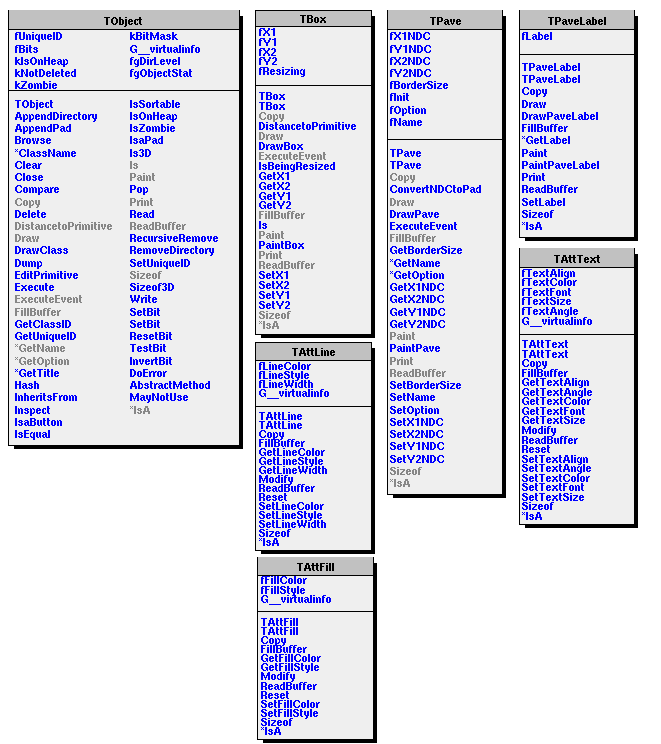
Reimplemented in TSystemDirectory, TSystemFile, and TGFrame.
Definition at line 307 of file TObject.cxx.
Draw a clone of this object in the current selected pad with: gROOT->SetSelectedPad(c1).
If pad was not selected - gPad will be used.
Reimplemented in TSystemDirectory, TSystemFile, TGFrame, TAxis, and TCanvas.
Definition at line 318 of file TObject.cxx.
|
virtualinherited |
Dump contents of object on stdout.
Using the information in the object dictionary (class TClass) each data member is interpreted. If a data member is a pointer, the pointer value is printed
The following output is the Dump of a TArrow object:
Reimplemented in TSystemFile, TCollection, TClass, TGFrame, and TGPack.
Definition at line 366 of file TObject.cxx.
|
virtualinherited |
Issue error message.
Use "location" to specify the method where the error occurred. Accepts standard printf formatting arguments.
Reimplemented in TFitResult.
Definition at line 1096 of file TObject.cxx.
|
virtualinherited |
Execute method on this object with the given parameter string, e.g.
"3.14,1,\"text\"".
Reimplemented in TMethodCall, TCling, TInterpreter, and TContextMenu.
Definition at line 377 of file TObject.cxx.
|
virtualinherited |
Execute method on this object with parameters stored in the TObjArray.
The TObjArray should contain an argv vector like:
Reimplemented in TCling, TMethodCall, TInterpreter, and TContextMenu.
Definition at line 397 of file TObject.cxx.
Execute action corresponding to one event.
This member function is called when the drawn class is clicked with the locator If Left button clicked on one of the line end points, this point follows the cursor until button is released.
if Middle button clicked, the line is moved parallel to itself until the button is released. Forward the call to the underlying graph
Reimplemented from TObject.
Definition at line 2453 of file TEfficiency.cxx.
|
virtualinherited |
Issue fatal error message.
Use "location" to specify the method where the fatal error occurred. Accepts standard printf formatting arguments.
Definition at line 1124 of file TObject.cxx.
|
static |
Calculates the boundaries for the frequentist Feldman-Cousins interval.
| total | number of total events |
| passed | 0 <= number of passed events <= total |
| level | confidence level |
| bUpper | true - upper boundary is returned false - lower boundary is returned |
Definition at line 1176 of file TEfficiency.cxx.
|
static |
Calculates the interval boundaries using the frequentist methods of Feldman-Cousins.
| [in] | total | number of total events |
| [in] | passed | 0 <= number of passed events <= total |
| [in] | level | confidence level |
| [out] | lower | lower boundary returned on exit |
| [out] | upper | lower boundary returned on exit |
Calculation:
The Feldman-Cousins is a frequentist method where the interval is estimated using a Neyman construction where the ordering is based on the likelihood ratio:
\[ LR = \frac{Binomial(k | N, \epsilon)}{Binomial(k | N, \hat{\epsilon} ) } \]
See G. J. Feldman and R. D. Cousins, Phys. Rev. D57 (1998) 3873 and R. D. Cousins, K. E. Hymes, J. Tucker, Nuclear Instruments and Methods in Physics Research A 612 (2010) 388
Implemented using classes developed by Jordan Tucker and Luca Lista See File hist/hist/src/TEfficiencyHelper.h
Definition at line 1209 of file TEfficiency.cxx.
This function is used for filling the two histograms.
| [in] | bPassed | flag whether the current event passed the selection
|
| [in] | x | x-value |
| [in] | y | y-value (use default=0 for 1-D efficiencies) |
| [in] | z | z-value (use default=0 for 2-D or 1-D efficiencies) |
Definition at line 2469 of file TEfficiency.cxx.
|
virtualinherited |
Encode TNamed into output buffer.
Reimplemented in TKeyXML, TXMLFile, TDirectoryFile, TFile, and TKey.
Definition at line 103 of file TNamed.cxx.
|
protected |
Fill the graph to be painted with information from TEfficiency Internal method called by TEfficiency::Paint or TEfficiency::CreateGraph.
Definition at line 1817 of file TEfficiency.cxx.
|
protected |
Fill the graph to be painted with information from TEfficiency Internal method called by TEfficiency::Paint or TEfficiency::CreateGraph.
Definition at line 1714 of file TEfficiency.cxx.
|
protected |
Fill the 2d histogram to be painted with information from TEfficiency 2D Internal method called by TEfficiency::Paint or TEfficiency::CreatePaintingGraph.
Definition at line 1939 of file TEfficiency.cxx.
| void TEfficiency::FillWeighted | ( | Bool_t | bPassed, |
| Double_t | weight, | ||
| Double_t | x, | ||
| Double_t | y = 0, | ||
| Double_t | z = 0 ) |
This function is used for filling the two histograms with a weight.
| [in] | bPassed | flag whether the current event passed the selection
|
| [in] | weight | weight for the event |
| [in] | x | x-value |
| [in] | y | y-value (use default=0 for 1-D efficiencies) |
| [in] | z | z-value (use default=0 for 2-D or 1-D efficiencies) |
Note: - this function will call SetUseWeightedEvents if it was not called by the user before
Definition at line 2503 of file TEfficiency.cxx.
Returns the global bin number containing the given values.
Note:
Definition at line 2539 of file TEfficiency.cxx.
|
virtualinherited |
Must be redefined in derived classes.
This function is typically used with TCollections, but can also be used to find an object by name inside this object.
Reimplemented in TListOfEnums, TMap, TDirectory, TFolder, TROOT, TListOfTypes, TListOfTypes, TBtree, TCollection, THashList, THashTable, TList, TObjArray, TListOfDataMembers, TListOfDataMembers, TListOfEnums, TListOfEnumsWithLock, TListOfFunctions, TListOfFunctionTemplates, TListOfFunctionTemplates, TViewPubDataMembers, TViewPubFunctions, TPad, THbookFile, TGraph, TGraph2D, TH1, RooAbsCollection, and RooLinkedList.
Definition at line 424 of file TObject.cxx.
Must be redefined in derived classes.
This function is typically used with TCollections, but can also be used to find an object inside this object.
Reimplemented in TMap, TDirectory, TFolder, TROOT, TListOfTypes, TBtree, TCollection, THashList, THashTable, TList, TObjArray, TListOfDataMembers, TListOfEnums, TListOfEnumsWithLock, TListOfFunctions, TListOfFunctionTemplates, TViewPubDataMembers, TViewPubFunctions, TPad, THbookFile, TGraph, TGraph2D, TH1, RooAbsCollection, and RooLinkedList.
Definition at line 434 of file TObject.cxx.
| TFitResultPtr TEfficiency::Fit | ( | TF1 * | f1, |
| Option_t * | opt = "" ) |
Fits the efficiency using the TBinomialEfficiencyFitter class.
The resulting fit function is added to the list of associated functions.
Options:
Definition at line 2564 of file TEfficiency.cxx.
Definition at line 110 of file TEfficiency.h.
Definition at line 111 of file TEfficiency.h.
|
inline |
Definition at line 112 of file TEfficiency.h.
| TH1 * TEfficiency::GetCopyPassedHisto | ( | ) | const |
Returns a cloned version of fPassedHistogram.
Notes:
Definition at line 2626 of file TEfficiency.cxx.
| TH1 * TEfficiency::GetCopyTotalHisto | ( | ) | const |
Returns a cloned version of fTotalHistogram.
Notes:
Definition at line 2656 of file TEfficiency.cxx.
| Int_t TEfficiency::GetDimension | ( | ) | const |
returns the dimension of the current TEfficiency object
Definition at line 2668 of file TEfficiency.cxx.
|
inline |
Definition at line 116 of file TEfficiency.h.
|
virtualinherited |
Get option used by the graphics system to draw this object.
Note that before calling object.GetDrawOption(), you must have called object.Draw(..) before in the current pad.
Reimplemented in TBrowser, TFitEditor, TGedFrame, TGFileBrowser, TRootBrowser, and TRootBrowserLite.
Definition at line 444 of file TObject.cxx.
|
staticinherited |
Return destructor only flag.
Definition at line 1194 of file TObject.cxx.
Returns the efficiency in the given global bin.
Note:
Definition at line 2690 of file TEfficiency.cxx.
Returns the lower error on the efficiency in the given global bin.
The result depends on the current confidence level fConfLevel and the chosen statistic option fStatisticOption. See SetStatisticOption(Int_t) for more details.
Note: If the histograms are filled with weights, only bayesian methods and the normal approximation are supported.
Definition at line 2741 of file TEfficiency.cxx.
Returns the upper error on the efficiency in the given global bin.
The result depends on the current confidence level fConfLevel and the chosen statistic option fStatisticOption. See SetStatisticOption(Int_t) for more details.
Note: If the histograms are filled with weights, only bayesian methods and the normal approximation are supported.
Definition at line 2821 of file TEfficiency.cxx.
|
inlinevirtualinherited |
Return the fill area color.
Reimplemented in TGraphMultiErrors, TGWin32, TGWin32VirtualXProxy, and TGX11.
Definition at line 32 of file TAttFill.h.
|
inlinevirtualinherited |
Return the fill area style.
Reimplemented in TGraphMultiErrors, TGWin32, TGWin32VirtualXProxy, and TGX11.
Definition at line 33 of file TAttFill.h.
Returns the global bin number which can be used as argument for the following functions:
see TH1::GetBin() for conventions on numbering bins
Definition at line 2899 of file TEfficiency.cxx.
|
virtualinherited |
Returns mime type name of object.
Used by the TBrowser (via TGMimeTypes class). Override for class of which you would like to have different icons for objects of the same class.
Reimplemented in TSystemFile, TGeoVolume, TASImage, TGMainFrame, TKey, ROOT::Experimental::XRooFit::xRooNode, TBranch, TVirtualBranchBrowsable, TMethodBrowsable, and TBranchElement.
Definition at line 471 of file TObject.cxx.
|
inlinevirtualinherited |
Return the line color.
Reimplemented in TGraphMultiErrors, and TGWin32VirtualXProxy.
Definition at line 36 of file TAttLine.h.
|
inlinevirtualinherited |
Return the line style.
Reimplemented in TGraphMultiErrors, TGWin32, TGWin32VirtualXProxy, and TGX11.
Definition at line 37 of file TAttLine.h.
|
inlinevirtualinherited |
Return the line width.
Reimplemented in TGraphMultiErrors, TGWin32, TGWin32VirtualXProxy, and TGX11.
Definition at line 38 of file TAttLine.h.
| TList * TEfficiency::GetListOfFunctions | ( | ) |
Definition at line 2906 of file TEfficiency.cxx.
|
inlinevirtualinherited |
Return the marker color.
Reimplemented in TGWin32VirtualXProxy.
Definition at line 34 of file TAttMarker.h.
Internal helper function that returns the line width of the given marker style (0 = filled marker)
Definition at line 292 of file TAttMarker.cxx.
|
inherited |
Return marker shape.
Depending from configured marker style different marker shapes are returned
| sz | return pixel size of the marker shape is returned (diamter for circle shapes) |
| shape | will contains vector of shape points |
| scale | defines scaling factor for size and shape coordinates |
| flags | let configure following options: kPreferTriangles - return kShapeTriangles instead of kShapeFilledArea, used when graphics engine not able to fill complex area kDotAsLines - convert small and medium dot into lines/fillrec which are directly drawn by pixel devices kDotAsCircle - automatically convert small and medium dots into circles kUsePSWidthScale - use gStyle->GetLineScalePS() for marker size calculations |
Definition at line 416 of file TAttMarker.cxx.
|
inlinevirtualinherited |
Return the marker size.
Reimplemented in TGWin32VirtualXProxy.
Definition at line 36 of file TAttMarker.h.
|
inlinevirtualinherited |
Return the marker style.
Reimplemented in TGWin32VirtualXProxy.
Definition at line 35 of file TAttMarker.h.
Internal helper function that returns the corresponding marker style with line width 1 for the given style.
Definition at line 259 of file TAttMarker.cxx.
|
inlineoverridevirtualinherited |
Returns string containing info about the object at position (px,py).
This method is typically overridden by classes of which the objects can report peculiarities for different positions. Returned string will be re-used (lock in MT environment).
Reimplemented in TGeoNode, TGeoVolume, TGeoTrack, TASImage, TColorWheel, TAxis3D, TGL5DDataSet, TGLHistPainter, TGLParametricEquation, TGLTH3Composition, TF1, TF2, TGraph, TH1, THistPainter, TPaletteAxis, TFileDrawMap, TParallelCoordVar, and TVirtualHistPainter.
Definition at line 490 of file TObject.cxx.
|
staticinherited |
Get status of object stat flag.
Definition at line 1179 of file TObject.cxx.
|
inlinevirtualinherited |
Reimplemented in TGeoVolume, TArrow, TGaxis, TLegendEntry, TPave, TPolyLine, TAxis3D, TPolyLine3D, TPolyMarker3D, TH1, TPolyMarker, TFile, TMapFile, TPSocket, TSocket, TUDPSocket, TSelector, and TPoints3DABC.
|
inline |
Definition at line 121 of file TEfficiency.h.
|
inline |
Definition at line 122 of file TEfficiency.h.
|
inline |
Definition at line 123 of file TEfficiency.h.
|
inline |
Definition at line 125 of file TEfficiency.h.
|
inline |
Definition at line 126 of file TEfficiency.h.
|
inlineoverridevirtualinherited |
|
inline |
Definition at line 127 of file TEfficiency.h.
|
virtualinherited |
Return the unique object id.
Definition at line 479 of file TObject.cxx.
|
inline |
Definition at line 128 of file TEfficiency.h.
Execute action in response of a timer timing out.
This method must be overridden if an object has to react to timers.
Reimplemented in TGWindow, TGuiBldDragManager, TGraphTime, TGLEventHandler, TGCommandPlugin, TGDNDManager, TGFileContainer, TGPopupMenu, TGScrollBar, TGShutter, TGTextEdit, TGTextEditor, TGTextEntry, TGTextView, TGToolTip, TGHtml, and TTreeViewer.
Definition at line 515 of file TObject.cxx.
|
inlineoverridevirtualinherited |
Return hash value for this object.
Note: If this routine is overloaded in a derived class, this derived class should also add
Otherwise, when RecursiveRemove is called (by ~TObject or example) for this type of object, the transversal of THashList and THashTable containers will will have to be done without call Hash (and hence be linear rather than logarithmic complexity). You will also see warnings like
Reimplemented from TObject.
|
inlineinherited |
Return true is the type of this object is known to have an inconsistent setup for Hash and RecursiveRemove (i.e.
missing call to RecursiveRemove in destructor).
Note: Since the consistency is only tested for during inserts, this routine will return true for object that have never been inserted whether or not they have a consistent setup. This has no negative side-effect as searching for the object with the right or wrong Hash will always yield a not-found answer (Since anyway no hash can be guaranteed unique, there is always a check)
|
virtualinherited |
Issue info message.
Use "location" to specify the method where the warning occurred. Accepts standard printf formatting arguments.
Definition at line 1070 of file TObject.cxx.
|
virtualinherited |
Returns kTRUE if object inherits from class "classname".
Reimplemented in TClass.
Definition at line 548 of file TObject.cxx.
Returns kTRUE if object inherits from TClass cl.
Reimplemented in TClass.
Definition at line 556 of file TObject.cxx.
|
virtualinherited |
Dump contents of this object in a graphics canvas.
Same action as Dump but in a graphical form. In addition pointers to other objects can be followed.
The following picture is the Inspect of a histogram object:

Reimplemented in TSystemFile, TInspectorObject, TGFrame, and ROOT::Experimental::XRooFit::xRooNode.
Definition at line 569 of file TObject.cxx.
|
inlineoverridevirtual |
Reimplemented from TObject.
Definition at line 194 of file TEfficiency.h.
|
inlineinherited |
IsDestructed.
Default equal comparison (objects are equal if they have the same address in memory).
More complicated classes might want to override this function.
Reimplemented in TObjString, TQCommand, TPair, and TGObject.
Definition at line 588 of file TObject.cxx.
|
virtualinherited |
Returns kTRUE in case object contains browsable objects (like containers or lists of other objects).
Reimplemented in TDirectory, TFolder, TRemoteObject, TROOT, TSystemDirectory, TTask, TCollection, TPair, TBrowserObject, TBaseClass, TClass, TGeoManager, TGeoNode, TGeoNodeMatrix, TGeoVolume, TGeoOverlap, TGeoTrack, TCanvas, TPad, TAxis3D, TRootIconList, THbookFile, THbookKey, THnBase, ROOT::Internal::THnBaseBrowsable, TMultiDimFit, TPrincipal, TKey, TMapFile, TSPlot, TDatabasePDG, TParticleClassPDG, TApplicationRemote, ROOT::Experimental::XRooFit::xRooNode, TBranch, TVirtualBranchBrowsable, TBranchClones, TBranchElement, TBranchObject, TBranchSTL, and TTree.
Definition at line 578 of file TObject.cxx.
|
inlineinherited |
|
inlineoverridevirtualinherited |
Reimplemented from TObject.
Reimplemented in TStructNodeProperty.
|
inlinevirtualinherited |
Reimplemented in TGWin32VirtualXProxy.
Definition at line 49 of file TAttFill.h.
|
inlineinherited |
|
overridevirtualinherited |
List TNamed name and title.
Reimplemented from TObject.
Reimplemented in ROOT::Experimental::XRooFit::xRooBrowser, TVirtualStreamerInfo, TROOT, TStreamerElement, TStreamerBase, TStreamerSTL, TText, TStreamerInfo, and TTask.
Definition at line 112 of file TNamed.cxx.
|
inherited |
Use this method to signal that a method (defined in a base class) may not be called in a derived class (in principle against good design since a child class should not provide less functionality than its parent, however, sometimes it is necessary).
Definition at line 1158 of file TObject.cxx.
| Long64_t TEfficiency::Merge | ( | TCollection * | pList | ) |
Merges the TEfficiency objects in the given list to the given TEfficiency object using the operator+=(TEfficiency&)
The merged result is stored in the current object. The statistic options and the confidence level are taken from the current object.
This function should be used when all TEfficiency objects correspond to the same process.
The new weight is set according to: \( \frac{1}{w_{new}} = \sum_{i} \frac{1}{w_{i}} \)
Definition at line 2924 of file TEfficiency.cxx.
|
static |
Calculates the boundaries using the mid-P binomial interval (Lancaster method) from B.
Cousing and J. Tucker. See http://arxiv.org/abs/0905.3831 for a description and references for the method
Modify equal_tailed to get the kind of interval you want. Can also be converted to interval on ratio of poisson means X/Y by the substitutions
Definition at line 1234 of file TEfficiency.cxx.
|
virtualinherited |
Change current fill area attributes if necessary.
Definition at line 212 of file TAttFill.cxx.
|
virtualinherited |
Change current line attributes if necessary.
Definition at line 246 of file TAttLine.cxx.
|
virtualinherited |
Change current marker attributes if necessary.
Definition at line 310 of file TAttMarker.cxx.
|
virtualinherited |
Change current fill area attributes on speicifed pad.
Definition at line 221 of file TAttFill.cxx.
|
virtualinherited |
Change current line attributes on specified pad.
Definition at line 255 of file TAttLine.cxx.
|
virtualinherited |
Change current marker attributes if necessary on specified pad.
Definition at line 319 of file TAttMarker.cxx.
|
static |
Returns the confidence limits for the efficiency supposing that the efficiency follows a normal distribution with the rms below.
| [in] | total | number of total events |
| [in] | passed | 0 <= number of passed events <= total |
| [in] | level | confidence level |
| [in] | bUpper |
|
Calculation:
\begin{eqnarray*} \hat{\varepsilon} &=& \frac{passed}{total}\\ \sigma_{\varepsilon} &=& \sqrt{\frac{\hat{\varepsilon} (1 - \hat{\varepsilon})}{total}}\\ \varepsilon_{low} &=& \hat{\varepsilon} \pm \Phi^{-1}(\frac{level}{2},\sigma_{\varepsilon}) \end{eqnarray*}
Definition at line 2961 of file TEfficiency.cxx.
|
virtualinherited |
This method must be overridden to handle object notification (the base implementation is no-op).
Different objects in ROOT use the Notify method for different purposes, in coordination with other objects that call this method at the appropriate time.
For example, TLeaf uses it to load class information; TBranchRef to load contents of referenced branches TBranchRef; most notably, based on Notify, TChain implements a callback mechanism to inform interested parties when it switches to a new sub-tree.
Reimplemented in TMessageHandler, TNotifyLink< Type >, TNotifyLink< RNoCleanupNotifierHelper >, TNotifyLink< ROOT::Detail::TBranchProxy >, TNotifyLink< TTreeReader >, TFileHandler, TSignalHandler, TStdExceptionHandler, TProcessEventTimer, TTimer, TIdleTimer, TSingleShotCleaner, TCollection, TRefTable, TBrowserTimer, TInterruptHandler, TTermInputHandler, TThreadTimer, TGLRedrawTimer, TViewTimer, TGContainerKeyboardTimer, TGContainerScrollTimer, TGInputHandler, TViewUpdateTimer, TPopupDelayTimer, TRepeatTimer, TSBRepeatTimer, TGTextEditHist, TInsCharCom, TDelCharCom, TBreakLineCom, TInsTextCom, TDelTextCom, TBlinkTimer, TTipDelayTimer, TGuiBldDragManagerRepeatTimer, TARInterruptHandler, TASLogHandler, TASInterruptHandler, TASSigPipeHandler, TASInputHandler, TSocketHandler, TTimeOutTimer, TBranchElement, TBranchRef, TLeafObject, TSelector, TTree, TSelectorDraw, TSelectorEntries, TTreeFormula, TTreeFormulaManager, TTreeReader, h1analysis, h1analysisTreeReader, and TSysEvtHandler.
Definition at line 617 of file TObject.cxx.
|
inherited |
Use this method to declare a method obsolete.
Specify as of which version the method is obsolete and as from which version it will be removed.
Definition at line 1167 of file TObject.cxx.
|
inherited |
Operator delete for sized deallocation.
Definition at line 1232 of file TObject.cxx.
|
inherited |
Operator delete.
Definition at line 1210 of file TObject.cxx.
|
inherited |
Only called by placement new when throwing an exception.
Definition at line 1264 of file TObject.cxx.
|
inherited |
Operator delete [] for sized deallocation.
Definition at line 1243 of file TObject.cxx.
|
inherited |
Operator delete [].
Definition at line 1221 of file TObject.cxx.
|
inherited |
Only called by placement new[] when throwing an exception.
Definition at line 1272 of file TObject.cxx.
|
inlineinherited |
|
inlineinherited |
|
inlineinherited |
| TEfficiency & TEfficiency::operator+= | ( | const TEfficiency & | rhs | ) |
Adds the histograms of another TEfficiency object to current histograms.
The statistic options and the confidence level remain unchanged.
fTotalHistogram += rhs.fTotalHistogram; fPassedHistogram += rhs.fPassedHistogram;
calculates a new weight: current weight of this TEfficiency object = \( w_{1} \) weight of rhs = \( w_{2} \) \( w_{new} = \frac{w_{1} \times w_{2}}{w_{1} + w_{2}} \)
Definition at line 2988 of file TEfficiency.cxx.
| TEfficiency & TEfficiency::operator= | ( | const TEfficiency & | rhs | ) |
Assignment operator.
The histograms, statistic option, confidence level, weight and paint styles of rhs are copied to the this TEfficiency object.
Note: - The list of associated functions is not copied. After this operation the list of associated functions is empty.
Definition at line 3030 of file TEfficiency.cxx.
|
overridevirtual |
Paints this TEfficiency object.
For details on the possible option see Draw(Option_t*)
Note for 1D classes In 1D the TEfficiency uses a TGraphAsymmErrors for drawing The TGraph is created only the first time Paint is used. The user can manipulate the TGraph via the method TEfficiency::GetPaintedGraph() The TGraph creates behing an histogram for the axis. The histogram is created also only the first time. If the axis needs to be updated because in the meantime the class changed use this trick which will trigger a re-calculation of the axis of the graph TEfficiency::GetPaintedGraph()->Set(0)
Note that in order to access the painted graph via GetPaintedGraph() you need either to call Paint or better gPad->Update();
Reimplemented from TObject.
Definition at line 3090 of file TEfficiency.cxx.
|
virtualinherited |
Pop on object drawn in a pad to the top of the display list.
I.e. it will be drawn last and on top of all other primitives.
Reimplemented in TPad, TFrame, and TVirtualPad.
Definition at line 639 of file TObject.cxx.
|
overridevirtualinherited |
Print TNamed name and title.
Reimplemented from TObject.
Reimplemented in TXMLFile, TScatter, TScatter2D, TParticleClassPDG, TParticlePDG, ROOT::Experimental::XRooFit::xRooNLLVar::xRooHypoPoint, ROOT::Experimental::XRooFit::xRooNLLVar::xRooHypoSpace, ROOT::Experimental::XRooFit::xRooNode, TPrincipal, TText, TSpectrum, TSpectrum2, TSpectrum3, TSQLColumnInfo, TSQLTableInfo, TTree, TTreeIndex, TParallelCoordVar, and TParallelCoordRange.
Definition at line 127 of file TNamed.cxx.
|
virtualinherited |
Read contents of object with specified name from the current directory.
First the key with the given name is searched in the current directory, next the key buffer is deserialized into the object. The object must have been created before via the default constructor. See TObject::Write().
Reimplemented in TKeyXML, TBuffer, and TKey.
Definition at line 672 of file TObject.cxx.
|
overridevirtual |
Recursively remove object from the list of functions.
Reimplemented from TObject.
Definition at line 3164 of file TEfficiency.cxx.
|
virtualinherited |
Reset this fill attributes to default values.
Reimplemented in TGWin32VirtualXProxy.
Definition at line 231 of file TAttFill.cxx.
|
virtualinherited |
Reset this line attributes to default values.
Reimplemented in TGWin32VirtualXProxy.
Definition at line 279 of file TAttLine.cxx.
|
virtualinherited |
Reset this marker attributes to the default values.
Reimplemented in TGWin32VirtualXProxy.
Definition at line 330 of file TAttMarker.cxx.
|
virtualinherited |
Save this object in the file specified by filename.
otherwise the object is written to filename as a CINT/C++ script. The C++ code to rebuild this object is generated via SavePrimitive(). The "option" parameter is passed to SavePrimitive. By default it is an empty string. It can be used to specify the Draw option in the code generated by SavePrimitive.
The function is available via the object context menu.
Reimplemented in TSpline, TFolder, TGeoVolume, TClassTree, TPad, TPaveClass, TGObject, TSpline3, TSpline5, ROOT::Experimental::XRooFit::xRooNode, TTreePerfStats, TVirtualPad, TGraph, and TH1.
Definition at line 707 of file TObject.cxx.
|
virtualinherited |
Save fill attributes as C++ statement(s) on output stream out.
Definition at line 240 of file TAttFill.cxx.
|
virtualinherited |
Save line attributes as C++ statement(s) on output stream out.
Definition at line 289 of file TAttLine.cxx.
|
virtualinherited |
Save line attributes as C++ statement(s) on output stream out.
Definition at line 340 of file TAttMarker.cxx.
|
overridevirtual |
Save primitive as a C++ statement(s) on output stream out.
Reimplemented from TObject.
Definition at line 3186 of file TEfficiency.cxx.
|
staticprotectedinherited |
Save object constructor in the output stream "out".
Can be used as first statement when implementing SavePrimitive() method for the object
Definition at line 776 of file TObject.cxx.
|
staticprotectedinherited |
Save invocation of primitive Draw() method Skipped if option contains "nodraw" string.
Definition at line 844 of file TObject.cxx.
|
protectedinherited |
Save object name and title into the output stream "out".
Definition at line 135 of file TNamed.cxx.
|
staticprotectedinherited |
Save array in the output stream "out" as vector.
Create unique variable name based on prefix value Returns name of vector which can be used in constructor or in other places of C++ code If flag === kTRUE, just add empty line If flag === 111, check if array is empty and return nullptr or <vectorname>.data()
Definition at line 795 of file TObject.cxx.
| void TEfficiency::SetBetaAlpha | ( | Double_t | alpha | ) |
Sets the shape parameter α.
The prior probability of the efficiency is given by the beta distribution:
\[ f(\varepsilon;\alpha;\beta) = \frac{1}{B(\alpha,\beta)} \varepsilon^{\alpha-1} (1 - \varepsilon)^{\beta-1} \]
Note: - both shape parameters have to be positive (i.e. > 0)
Definition at line 3292 of file TEfficiency.cxx.
| void TEfficiency::SetBetaBeta | ( | Double_t | beta | ) |
Sets the shape parameter β.
The prior probability of the efficiency is given by the beta distribution:
\[ f(\varepsilon;\alpha,\beta) = \frac{1}{B(\alpha,\beta)} \varepsilon^{\alpha-1} (1 - \varepsilon)^{\beta-1} \]
Note: - both shape parameters have to be positive (i.e. > 0)
Definition at line 3310 of file TEfficiency.cxx.
Sets different shape parameter α and β for the prior distribution for each bin.
By default the global parameter are used if they are not set for the specific bin The prior probability of the efficiency is given by the beta distribution:
\[ f(\varepsilon;\alpha;\beta) = \frac{1}{B(\alpha,\beta)} \varepsilon^{\alpha-1} (1 - \varepsilon)^{\beta-1} \]
Note:
Definition at line 3331 of file TEfficiency.cxx.
Set the bins for the underlined passed and total histograms If the class have been already filled the previous contents will be lost.
Definition at line 3372 of file TEfficiency.cxx.
Set the bins for the underlined passed and total histograms If the class have been already filled the previous contents will be lost.
Definition at line 3412 of file TEfficiency.cxx.
| Bool_t TEfficiency::SetBins | ( | Int_t | nx, |
| const Double_t * | xBins, | ||
| Int_t | ny, | ||
| const Double_t * | yBins, | ||
| Int_t | nz, | ||
| const Double_t * | zBins ) |
Set the bins for the underlined passed and total histograms If the class have been already filled the previous contents will be lost.
Definition at line 3453 of file TEfficiency.cxx.
Set the bins for the underlined passed and total histograms If the class have been already filled the previous contents will be lost.
Definition at line 3352 of file TEfficiency.cxx.
| Bool_t TEfficiency::SetBins | ( | Int_t | nx, |
| Double_t | xmin, | ||
| Double_t | xmax, | ||
| Int_t | ny, | ||
| Double_t | ymin, | ||
| Double_t | ymax ) |
Set the bins for the underlined passed and total histograms If the class have been already filled the previous contents will be lost.
Definition at line 3392 of file TEfficiency.cxx.
| Bool_t TEfficiency::SetBins | ( | Int_t | nx, |
| Double_t | xmin, | ||
| Double_t | xmax, | ||
| Int_t | ny, | ||
| Double_t | ymin, | ||
| Double_t | ymax, | ||
| Int_t | nz, | ||
| Double_t | zmin, | ||
| Double_t | zmax ) |
Set the bins for the underlined passed and total histograms If the class have been already filled the previous contents will be lost.
Definition at line 3432 of file TEfficiency.cxx.
Set or unset the user status bits as specified in f.
Definition at line 886 of file TObject.cxx.
|
inline |
Definition at line 146 of file TEfficiency.h.
| void TEfficiency::SetConfidenceLevel | ( | Double_t | level | ) |
Sets the confidence level (0 < level < 1) The default value is 1-sigma :~ 0.683.
Definition at line 3474 of file TEfficiency.cxx.
| void TEfficiency::SetDirectory | ( | TDirectory * | dir | ) |
Sets the directory holding this TEfficiency object.
A reference to this TEfficiency object is removed from the current directory (if it exists) and a new reference to this TEfficiency object is added to the given directory.
Notes:
Definition at line 3495 of file TEfficiency.cxx.
|
virtualinherited |
Set drawing option for object.
This option only affects the drawing style and is stored in the option field of the TObjOptLink supporting a TPad's primitive list (TList). Note that it does not make sense to call object.SetDrawOption(option) before having called object.Draw().
Reimplemented in TSystemDirectory, TSystemFile, TPad, TGFrame, TAxis, TBrowser, TPaveStats, TGedFrame, TRootBrowserLite, and RooPlot.
Definition at line 870 of file TObject.cxx.
|
staticinherited |
Set destructor only flag.
Definition at line 1202 of file TObject.cxx.
|
virtualinherited |
Invoke the DialogCanvas Fill attributes.
Reimplemented in TGWin32VirtualXProxy.
Definition at line 251 of file TAttFill.cxx.
|
inlinevirtualinherited |
Set the fill area color.
Reimplemented in TVirtualX, TGQuartz, TGWin32, TGWin32VirtualXProxy, TGX11, TPDF, TPostScript, TSVG, TTeXDump, TSpider, and TGraphMultiErrors.
Definition at line 40 of file TAttFill.h.
|
inherited |
Set a fill color.
Definition at line 270 of file TAttFill.cxx.
Set a transparent fill color.
| fcolor | defines the fill color |
| falpha | defines the percentage of opacity from 0. (fully transparent) to 1. (fully opaque). |
Reimplemented in TGraphMultiErrors.
Definition at line 262 of file TAttFill.cxx.
|
inlinevirtualinherited |
Set the fill area style.
Reimplemented in TGraphMultiErrors, TPad, TSpider, TVirtualX, TGQuartz, TGWin32, TGWin32VirtualXProxy, and TGX11.
Definition at line 42 of file TAttFill.h.
|
virtualinherited |
Invoke the DialogCanvas Line attributes.
Reimplemented in TGWin32VirtualXProxy.
Definition at line 306 of file TAttLine.cxx.
|
inlinevirtualinherited |
Set the line color.
Reimplemented in TEveTrackList, ROOT::Experimental::REveTrackList, TVirtualX, TGQuartz, TGWin32, TGWin32VirtualXProxy, TGX11, TPDF, TPostScript, TSVG, TTeXDump, TEveLine, TEveStraightLineSet, ROOT::Experimental::REveLine, ROOT::Experimental::REveStraightLineSet, TParallelCoordRange, TSpider, TGraphMultiErrors, TGeoVolume, and TGeoVolumeMulti.
Definition at line 44 of file TAttLine.h.
|
inherited |
Definition at line 322 of file TAttLine.cxx.
Set a transparent line color.
| lcolor | defines the line color |
| lalpha | defines the percentage of opacity from 0. (fully transparent) to 1. (fully opaque). |
Reimplemented in TGraphMultiErrors.
Definition at line 317 of file TAttLine.cxx.
|
inlinevirtualinherited |
Set the line style.
Reimplemented in TVirtualX, TGQuartz, TGWin32, TGWin32VirtualXProxy, TGX11, TPDF, TPostScript, TSVG, TTeXDump, TGraphMultiErrors, TGeoVolume, TGeoVolumeMulti, TEveLine, ROOT::Experimental::REveLine, TEveTrackList, ROOT::Experimental::REveTrackList, and TSpider.
Definition at line 46 of file TAttLine.h.
|
inlinevirtualinherited |
Set the line width.
Reimplemented in TPDF, TPostScript, TSVG, TTeXDump, TGraphMultiErrors, TGeoVolume, TGeoVolumeMulti, TEveLine, ROOT::Experimental::REveLine, TEveTrackList, ROOT::Experimental::REveTrackList, TParallelCoordRange, TSpider, TVirtualX, TGQuartz, TGWin32, TGWin32VirtualXProxy, TGX11, and TPaletteAxis.
Definition at line 47 of file TAttLine.h.
|
virtualinherited |
Invoke the DialogCanvas Marker attributes.
Reimplemented in TGWin32VirtualXProxy.
Definition at line 353 of file TAttMarker.cxx.
|
virtualinherited |
Set the marker color.
Reimplemented in TEveTrackList, ROOT::Experimental::REveTrackList, TVirtualX, TGQuartz, TGWin32, TGWin32VirtualXProxy, TGX11, TPDF, TPostScript, TSVG, TTeXDump, TEveLine, TEvePointSet, ROOT::Experimental::REveLine, ROOT::Experimental::REvePointSet, TEvePointSetArray, and ROOT::Experimental::REvePointSetArray.
Definition at line 372 of file TAttMarker.cxx.
|
inherited |
Set the marker color.
Definition at line 380 of file TAttMarker.cxx.
Set a transparent marker color.
| mcolor | defines the marker color |
| malpha | defines the percentage of opacity from 0. (fully transparent) to 1. (fully opaque). |
Definition at line 364 of file TAttMarker.cxx.
|
virtualinherited |
Set the marker size.
Note that the marker styles number 1 6 and 7 (the dots), cannot be scaled. They are meant to be very fast to draw and are always drawn with the same number of pixels; therefore this method does not apply on them.
Reimplemented in TVirtualX, TGQuartz, TGWin32, TGWin32VirtualXProxy, TGX11, TTeXDump, TEvePointSet, TEvePointSetArray, ROOT::Experimental::REvePointSet, ROOT::Experimental::REvePointSetArray, TEveTrackList, and ROOT::Experimental::REveTrackList.
Definition at line 399 of file TAttMarker.cxx.
|
virtualinherited |
Set the marker style.
Reimplemented in TVirtualX, TGQuartz, TGWin32, TGWin32VirtualXProxy, TGX11, TEvePointSet, TEvePointSetArray, ROOT::Experimental::REvePointSet, ROOT::Experimental::REvePointSetArray, TEveTrackList, and ROOT::Experimental::REveTrackList.
Definition at line 388 of file TAttMarker.cxx.
|
overridevirtual |
Sets the name.
Note: The names of the internal histograms are set to "name + _total" and "name + _passed" respectively.
Reimplemented from TNamed.
Definition at line 3512 of file TEfficiency.cxx.
|
virtualinherited |
Set all the TNamed parameters (name and title).
WARNING: if the name is changed and the object is a member of a THashTable or THashList container the container must be Rehash()'ed after SetName(). For example the list of objects in the current directory is a THashList.
Reimplemented in TContextMenu, TGraph2D, TH1, RooAbsArg, RooAbsData, RooDataHist, RooDataSet, RooFitResult, RooPlot, and TGraph.
Definition at line 163 of file TNamed.cxx.
|
staticinherited |
Turn on/off tracking of objects in the TObjectTable.
Definition at line 1186 of file TObject.cxx.
Sets the number of passed events in the given global bin.
returns "true" if the number of passed events has been updated otherwise "false" ist returned
Note: - requires: 0 <= events <= fTotalHistogram->GetBinContent(bin)
Definition at line 3531 of file TEfficiency.cxx.
Sets the histogram containing the passed events.
The given histogram is cloned and stored internally as histogram containing the passed events. The given histogram has to be consistent with the current fTotalHistogram (see CheckConsistency(const TH1&,const TH1&)). The method returns whether the fPassedHistogram has been replaced (true) or not (false).
Note: The list of associated functions fFunctions is cleared.
Option:
Definition at line 3562 of file TEfficiency.cxx.
|
inline |
Definition at line 144 of file TEfficiency.h.
|
inline |
Definition at line 143 of file TEfficiency.h.
|
inline |
Definition at line 145 of file TEfficiency.h.
| void TEfficiency::SetStatisticOption | ( | EStatOption | option | ) |
Sets the statistic option which affects the calculation of the confidence interval.
Options:
Definition at line 3627 of file TEfficiency.cxx.
|
overridevirtual |
Sets the title.
Notes:
Example: Setting the title to "My Efficiency" and label the axis pEff->SetTitle("My Efficiency;x label;eff");
Reimplemented from TNamed.
Definition at line 3691 of file TEfficiency.cxx.
Sets the number of total events in the given global bin.
returns "true" if the number of total events has been updated otherwise "false" ist returned
Note: - requires: fPassedHistogram->GetBinContent(bin) <= events
Definition at line 3725 of file TEfficiency.cxx.
Sets the histogram containing all events.
The given histogram is cloned and stored internally as histogram containing all events. The given histogram has to be consistent with the current fPassedHistogram (see CheckConsistency(const TH1&,const TH1&)). The method returns whether the fTotalHistogram has been replaced (true) or not (false).
Note: The list of associated functions fFunctions is cleared.
Option:
Definition at line 3756 of file TEfficiency.cxx.
|
virtualinherited |
Set the unique object id.
Definition at line 897 of file TObject.cxx.
Definition at line 3790 of file TEfficiency.cxx.
| void TEfficiency::SetWeight | ( | Double_t | weight | ) |
Sets the global weight for this TEfficiency object.
Note: - weight has to be positive ( > 0)
Definition at line 3808 of file TEfficiency.cxx.
|
virtualinherited |
Return size of the TNamed part of the TObject.
Reimplemented in TXMLFile, TDirectory, TDirectoryFile, TFile, and TKey.
Definition at line 182 of file TNamed.cxx.
|
overridevirtual |
|
inline |
Definition at line 194 of file TEfficiency.h.
|
virtualinherited |
Issue system error message.
Use "location" to specify the method where the system error occurred. Accepts standard printf formatting arguments.
Definition at line 1110 of file TObject.cxx.
|
inlineinherited |
|
virtualinherited |
Set current style settings in this object This function is called when either TCanvas::UseCurrentStyle or TROOT::ForceStyle have been invoked.
Reimplemented in TCanvas, TPad, TFrame, TPaveStats, TPaveText, TAxis3D, TGraph, TH1, and TTree.
Definition at line 907 of file TObject.cxx.
|
inline |
Definition at line 162 of file TEfficiency.h.
|
inline |
Definition at line 166 of file TEfficiency.h.
|
inline |
Definition at line 165 of file TEfficiency.h.
|
inline |
Definition at line 163 of file TEfficiency.h.
|
inline |
Definition at line 164 of file TEfficiency.h.
|
inline |
Definition at line 167 of file TEfficiency.h.
|
virtualinherited |
Issue warning message.
Use "location" to specify the method where the warning occurred. Accepts standard printf formatting arguments.
Definition at line 1082 of file TObject.cxx.
|
static |
Calculates the boundaries for the frequentist Wilson interval.
| [in] | total | number of total events |
| [in] | passed | 0 <= number of passed events <= total |
| [in] | level | confidence level |
| [in] | bUpper |
|
Calculation:
\begin{eqnarray*} \alpha &=& 1 - \frac{level}{2}\\ \kappa &=& \Phi^{-1}(1 - \alpha,1) ...\ normal\ quantile\ function\\ mode &=& \frac{passed + \frac{\kappa^{2}}{2}}{total + \kappa^{2}}\\ \Delta &=& \frac{\kappa}{total + \kappa^{2}} * \sqrt{passed (1 - \frac{passed}{total}) + \frac{\kappa^{2}}{4}}\\ return &=& max(0,mode - \Delta)\ or\ min(1,mode + \Delta) \end{eqnarray*}
Definition at line 3838 of file TEfficiency.cxx.
|
virtualinherited |
Write this object to the current directory.
For more see the const version of this method.
Reimplemented in TXMLFile, TDirectory, TBuffer, ROOT::TBufferMergerFile, TDirectoryFile, TFile, TParallelMergingFile, TCollection, TMap, and TTree.
Definition at line 987 of file TObject.cxx.
|
virtualinherited |
Write this object to the current directory.
The data structure corresponding to this object is serialized. The corresponding buffer is written to the current directory with an associated key with name "name".
Writing an object to a file involves the following steps:
Bufsize can be given to force a given buffer size to write this object. By default, the buffersize will be taken from the average buffer size of all objects written to the current file so far.
If a name is specified, it will be the name of the key. If name is not given, the name of the key will be the name as returned by GetName().
The option can be a combination of: kSingleKey, kOverwrite or kWriteDelete Using the kOverwrite option a previous key with the same name is overwritten. The previous key is deleted before writing the new object. Using the kWriteDelete option a previous key with the same name is deleted only after the new object has been written. This option is safer than kOverwrite but it is slower. NOTE: Neither kOverwrite nor kWriteDelete reduces the size of a TFile– the space is simply freed up to be overwritten; in the case of a TTree, it is more complicated. If one opens a TTree, appends some entries, then writes it out, the behaviour is effectively the same. If, however, one creates a new TTree and writes it out in this way, only the metadata is replaced, effectively making the old data invisible without deleting it. TTree::Delete() can be used to mark all disk space occupied by a TTree as free before overwriting its metadata this way. The kSingleKey option is only used by TCollection::Write() to write a container with a single key instead of each object in the container with its own key.
An object is read from the file into memory via TKey::Read() or via TObject::Read().
The function returns the total number of bytes written to the file. It returns 0 if the object cannot be written.
Reimplemented in TXMLFile, TDirectory, TBuffer, TDirectoryFile, TFile, TParallelMergingFile, TCollection, TMap, and TTree.
Definition at line 962 of file TObject.cxx.
|
protected |
Global parameter for prior beta distribution (default = 1)
Definition at line 47 of file TEfficiency.h.
|
protected |
Global parameter for prior beta distribution (default = 1)
Definition at line 48 of file TEfficiency.h.
Parameter for prior beta distribution different bin by bin (default vector is empty)
Definition at line 49 of file TEfficiency.h.
|
privateinherited |
! Pointer to a method calculating the boundaries of confidence intervals
Definition at line 51 of file TEfficiency.h.
|
protected |
Confidence level (default = 0.683, 1 sigma)
Definition at line 52 of file TEfficiency.h.
|
protected |
! Pointer to directory holding this TEfficiency object
Definition at line 53 of file TEfficiency.h.
|
protectedinherited |
Fill area color.
Definition at line 24 of file TAttFill.h.
|
protectedinherited |
Fill area style.
Definition at line 25 of file TAttFill.h.
|
protected |
->Pointer to list of functions
Definition at line 54 of file TEfficiency.h.
|
staticprivateinherited |
if true keep track of objects in TObjectTable
|
protectedinherited |
Line color.
Definition at line 24 of file TAttLine.h.
|
protectedinherited |
Line style.
Definition at line 25 of file TAttLine.h.
|
protectedinherited |
Line width.
Definition at line 26 of file TAttLine.h.
|
protectedinherited |
Marker color.
Definition at line 25 of file TAttMarker.h.
|
protectedinherited |
Marker size.
Definition at line 27 of file TAttMarker.h.
|
protectedinherited |
Marker style.
Definition at line 26 of file TAttMarker.h.
|
protected |
! Temporary graph for painting
Definition at line 55 of file TEfficiency.h.
|
protected |
! Temporary graph for painting
Definition at line 56 of file TEfficiency.h.
|
protected |
! Temporary histogram for painting
Definition at line 57 of file TEfficiency.h.
|
protected |
Histogram for events which passed certain criteria.
Definition at line 58 of file TEfficiency.h.
|
protected |
Defines how the confidence intervals are determined.
Definition at line 59 of file TEfficiency.h.
|
protected |
Histogram for total number of events.
Definition at line 60 of file TEfficiency.h.
|
privateinherited |
|
protected |
Weight for all events (default = 1)
Definition at line 61 of file TEfficiency.h.

